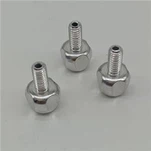
Types of Parts That Require Precision Mechanical Components Machining
In modern manufacturing, precision mechanical components machining plays a crucial role. It produces high-precision and high-quality parts that meet various complex and high-end application requirements. However, not all parts require precision mechanical machining. Only those with strict requirements for dimensional accuracy, surface quality, and material performance are processed using this method.
I. Parts with Extremely High Dimensional Accuracy Requirements
In the aerospace industry, a typical example is the turbine blade of an engine. Turbine blades operate in harsh conditions of high temperature, high pressure, and high rotational speed. Their dimensional accuracy directly affects the performance and efficiency of the engine. The profile tolerance of the blade is usually required to be controlled within ±0.05mm or even smaller. Any minor dimensional deviation can cause imbalance during high-speed rotation, leading to vibrations that reduce engine reliability and may even cause flight accidents in severe cases.
Another example is the lens assembly of a photolithography machine in semiconductor manufacturing equipment. The photolithography machine is a core device for chip manufacturing, and the precision of the lens determines the minimum feature size of the chip. To achieve nanometer-level lithography accuracy, the radius of curvature, thickness, and other dimensional tolerances of the optical lenses must be controlled at the nanometer level. This requires the use of precision mechanical machining technology, such as ultra-precision grinding and polishing, to meet such high-precision requirements.
II. Parts with Strict Surface Quality Requirements
Artificial joints in medical devices are a typical example. Artificial joints are implanted in the human body for long periods and directly contact human tissues. Their surface quality not only affects the wear resistance and service life of the joint but also impacts patient comfort and recovery outcomes. Surface roughness must be controlled at an extremely low level, typically below Ra 0.1μm, to reduce friction and wear during joint movement and prevent bacterial growth due to surface roughness, thereby lowering the risk of infection.
Another example is the mirrors in optical instruments. The surface quality of mirrors directly affects the imaging quality of optical systems. Even extremely minor surface flaws or unevenness can cause light scattering and reflection errors, resulting in blurred and distorted images. Therefore, the machining of mirrors requires ultra-precision polishing processes to achieve atomic-level smoothness, ensuring that light reflects accurately along the intended path.
III. Parts with Special Material Properties and High Machining Difficulty
In the manufacturing of batteries for new energy vehicles, the machining of battery electrodes presents many challenges. Battery electrodes are typically made of metals such as copper and aluminum. To improve the energy density and charging/discharging performance of the battery, the electrode materials often have special microstructures and component ratios. During machining, it is necessary to ensure that the material's microstructure is not damaged while meeting high-precision dimensional requirements. For example, the thickness tolerance of the electrode must be controlled within ±0.02mm, which requires advanced precision machining equipment and processes.
Components in aircraft engine combustion chambers are another example. These parts operate in environments with high temperatures, high pressures, and high corrosion, requiring the use of high-temperature-resistant, high-strength, and corrosion-resistant alloy materials, such as nickel-based alloys. These materials are hard and prone to work hardening, making them difficult to machine using traditional methods. Precision mechanical machining, through the use of special machining techniques such as electrical discharge machining (EDM) and electrochemical machining (ECM), can process these difficult-to-machine materials while ensuring dimensional accuracy and surface quality.
Conclusion
In summary, parts that require extremely high dimensional accuracy, strict surface quality, and those with special material properties and high machining difficulty all need precision mechanical components machining. With the continuous progress of technology and the high-end development of manufacturing, the demand for precision mechanical machining will continue to grow. This also drives continuous innovation and improvement in related technologies to meet the increasing demand for high-precision parts in various fields.