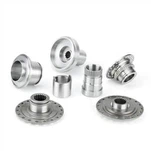
Can General Mechanical Machining Equipment Process Precision Mechanical Components?
In the field of mechanical manufacturing, the quality of precision mechanical components machining directly affects the performance and reliability of various high-end equipment. General mechanical machining equipment is widely used in many production scenarios. Thus, a question worth exploring arises: Can general mechanical machining equipment process precision mechanical components?
I. Characteristics and Limitations of General Mechanical Machining Equipment
(1) Precision
General mechanical machining equipment, such as ordinary lathes, milling machines, and drilling machines, has relatively limited precision. For example, a typical lathe may have a positioning accuracy of around ±0.05mm and a repeatability of around ±0.03mm. This level of precision is sufficient for conventional mechanical parts, such as ordinary shafts and disc-shaped components, to meet tolerance requirements. However, precision mechanical components often require extremely high dimensional accuracy. For instance, in the aerospace field, some components may have tolerances controlled within ±0.01mm or even smaller ranges. The precision of a general lathe is insufficient to meet such stringent requirements, and parts processed with it may have significant dimensional deviations, failing to meet the precision standards of precision mechanical components.
(2) Stability
General mechanical machining equipment is less stable during operation compared to specialized precision machining equipment. After prolonged operation, factors such as mechanical wear and backlash in the transmission system can gradually degrade machining accuracy. For example, after several hours of continuous operation, a milling machine may experience some degree of tool position deviation. This deviation may not significantly affect parts with lower precision requirements, but for precision mechanical components, even minor deviations can cause the shape and dimensional accuracy to exceed allowable limits.
(3) Automation Level and Control Precision
General mechanical machining equipment typically has a lower level of automation, with many operations relying on manual control. Inconsistencies in manual operation can introduce errors. Even if some equipment has certain automated functions, the precision and response speed of its control system still lag behind those of precision machining equipment. For example, during complex contour machining tasks, a general CNC machining center may struggle to accurately follow small contour curves due to its limited interpolation precision, failing to meet the high-precision contour machining requirements of precision mechanical components.
II. Special Requirements for Precision Mechanical Components Machining
(1) High Precision Requirements
Precision mechanical components machining demands extremely high accuracy in terms of dimensional precision, shape precision, and surface roughness. As mentioned earlier, some critical components have very tight tolerances. In terms of shape precision, components such as precision mold cavities and aircraft engine blades require shape errors (e.g., flatness, cylindricity, roundness) to be controlled at the micrometer level. Regarding surface roughness, for example, in the machining of optical lenses, the surface roughness Ra value is typically required to be between 0.01μm and 0.02μm. Such smooth surfaces are difficult to achieve with general mechanical machining equipment.
(2) Complex Process Requirements
Precision mechanical components often require complex machining processes. For example, components with small holes, deep holes, or complex irregular structures may need special machining processes such as electrical discharge machining (EDM), electrochemical machining (ECM), and laser machining. These specialized processes require dedicated equipment and technical support, which general mechanical machining equipment usually lacks, making it impossible to complete the corresponding machining tasks. Moreover, the planning of machining process routes for precision components is more complex and meticulous, requiring consideration of the impact of machining sequence on part accuracy and residual stress. This is another challenge that general mechanical machining equipment faces when processing precision components.
(3) Environmental Requirements
Precision mechanical components machining typically has strict requirements for the machining environment. Factors such as temperature, humidity, and vibration can affect machining accuracy. For example, during ultra-precision machining, even minor temperature changes can cause thermal expansion and contraction of parts and equipment, thereby affecting machining accuracy. The workshop environment where general mechanical machining equipment is located often lacks strict temperature control, humidity control, and vibration isolation, making it difficult to meet the environmental requirements for precision mechanical components machining.