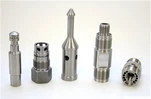
Plastic precision machining is the process of manufacturing parts from plastic materials with high accuracy and close tolerances. This method is particularly useful for producing complex shapes and intricate designs that are either difficult or too costly to achieve through traditional plastic processing methods like injection molding. Here's an introduction to plastic precision machining:
What is Plastic Precision Machining?
Definition: It is a specialized manufacturing process that involves cutting, shaping, and finishing plastic materials to create parts with precise dimensions.
Materials: A wide range of thermoplastic materials can be used, including but not limited to polyethylene, polypropylene, acrylic, nylon, and polycarbonate.
Applications: Plastic precision machining is used in various industries, such as medical, electronics, automotive, aerospace, and consumer goods.
Techniques in Plastic Precision Machining
CNC Machining: Computer Numerical Control (CNC) machines are programmed to cut and shape plastic blocks or sheets to the desired design with high precision.
Routing: A form of CNC machining where a cutting tool is guided along the轮廓 (contours) of a design in 2D or 3D space.
Turning: Similar to metal turning, plastic materials can be turned on a lathe to create cylindrical parts with precise diameters and lengths.
Milling: The use of a milling machine to remove material from solid plastic blocks to create complex 3D shapes.
Grinding and Polishing: These processes are used to achieve a fine surface finish and tight tolerances on plastic parts.
Drilling: Precision drilling is used to create holes in plastic parts with a specific diameter and depth.
Ultrasonic Machining: A process that uses ultrasonic vibrations and an abrasive slurry to machine hard-to-cut materials.
Water Jet Cutting: A method that uses a high-pressure jet of water, sometimes with an abrasive garnet mixture, to cut through plastic materials.
Benefits of Plastic Precision Machining
Complex Shapes: The ability to produce parts with complex geometries that are not feasible with standard plastic manufacturing techniques.
Low-Volume Production: Ideal for creating small batches or prototypes without the high setup costs associated with injection molding.
Material Properties: Plastics offer advantages like corrosion resistance, lightweight, and the ability to be transparent or colored.
Lead Time: Faster turnaround times compared to traditional plastic part manufacturing methods.
Customization: Easy to customize parts for specific applications without significant additional costs.
Precision: High precision and repeatability in the dimensions of the finished parts.
Considerations in Plastic Precision Machining
Material Selection: The choice of plastic material depends on the part's function, required tolerances, and the operating environment.
Tool Wear: Plastics can be abrasive or cause tool adhesion; thus, using the right tools and coatings is essential.
Thermal Expansion: Plastics expand more than metals when heated, which must be considered in the machining process.
Stress and Deformation: Plastic parts can deform under their own weight or external forces, so design and material selection are crucial.
Finishing: Post-machining finishing processes may be required to achieve the desired surface quality or to remove machining marks.
Future Trends in Plastic Precision Machining
Material Innovations: The development of new plastic materials with enhanced properties, such as improved strength, temperature resistance, or electrical conductivity.
Automation: Increased use of robotics and automation to improve efficiency, precision, and reduce labor costs.
Sustainability: A focus on using recycled or biodegradable plastics and minimizing waste in the machining process.
Digitalization: The use of digital twins and simulation software to optimize machining processes before physical production.
Miniaturization: Advances in precision machining to produce increasingly smaller and more intricate plastic components for applications like microfluidics and wearable technology.
Plastic precision machining is a versatile and valuable process for creating high-precision plastic parts with complex geometries. As technology and material science continue to progress, the capabilities and applications of this manufacturing method will expand, offering even more possibilities for designers and manufacturers.