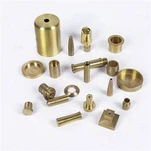
Metal parts machining is a fundamental manufacturing process that transforms raw metal materials into precise components through controlled material removal. This subtractive manufacturing approach utilizes various cutting tools, abrasives, and energy sources to achieve specific geometries, dimensions, and surface finishes. From simple brackets to complex aerospace components, metal machining serves diverse industries including automotive, medical, electronics, and heavy machinery.
Primary Machining Processes
1. CNC Machining (Computer Numerical Control)
CNC machining represents the cornerstone of modern metal parts manufacturing:
CNC Milling:
Uses rotating multi-point cutting tools to remove material
Employs 3 to 5-axis movements for complex geometries
Achieves tolerances within ±0.01mm for precision components
Suitable for flat surfaces, pockets, slots, and 3D contours
Materials: Aluminum, steel, titanium, brass, and engineering plastics
CNC Turning:
Rotates workpiece while stationary cutting tool removes material
Ideal for cylindrical and symmetrical components
Produces shafts, bushings, pins, and threaded parts
Surface finishes typically Ra 0.8-1.6μm achievable
Combines with live tooling for off-center features
Applications:
Automotive: Engine components, transmission parts, gears
Aerospace: Structural components, landing gear parts
Medical: Surgical instruments, implants, prosthetics
Electronics: Heat sinks, enclosures, connectors
2. Metal Forming and Stamping
Sheet metal processing creates functional components:
Processes:
Punching and Blanking: Creates holes and cutouts using hardened dies
Bending: Forms angles and channels with press brakes
Deep Drawing: Produces complex 3D shapes from flat sheets
Progressive Stamping: Multiple operations in sequential stations
Advantages:
High production rates for large volumes
Excellent repeatability and consistency
Cost-effective for medium to high volumes
Minimal material waste through optimal nesting
Wide range of materials: Steel, aluminum, copper, stainless steel
Applications:
Automotive body panels and structural components
Electronic enclosures and chassis
Appliance housings and brackets
Construction hardware and fixtures
3. Metal Casting Processes
Casting produces complex shapes through molten metal:
Investment Casting (Lost-Wax Process):
Creates wax patterns coated with ceramic shell
Achieves exceptional surface finish (Ra 3.2-6.3μm)
Tolerances: ±0.1-0.5mm depending on part size
Suitable for complex geometries and internal features
Materials: Steel, stainless steel, aluminum, bronze
Die Casting:
Injects molten metal into steel dies under high pressure
Produces near-net-shape components
Excellent dimensional accuracy (±0.1mm)
Smooth surface finish requiring minimal machining
High-volume production capability
Sand Casting:
Uses sand molds for large components
Cost-effective for low to medium volumes
Accommodates large part sizes
Suitable for complex internal geometries
Materials: Iron, aluminum, bronze, magnesium
4. Forging Operations
Forging enhances mechanical properties through controlled deformation:
Process Types:
Open-Die Forging: Shapes metal between flat dies
Closed-Die Forging: Forms parts in precision die cavities
Ring Rolling: Produces seamless rings
Precision Forging: Near-net-shape with minimal machining
Benefits:
Improved grain structure and mechanical properties
Superior strength-to-weight ratio
Excellent fatigue resistance
Reduced material waste
Directional strength characteristics
Applications:
Aerospace landing gear components
Automotive crankshafts and connecting rods
Oil and gas drilling equipment
Power generation turbine parts
5. Advanced Manufacturing Processes
Metal Injection Molding (MIM):
Combines metal powder with polymer binder
Produces complex small parts in high volumes
Achieves 95-99% theoretical density
Tolerances: ±0.1-0.3mm
Materials: Stainless steel, titanium, nickel alloys
Metal 3D Printing (Additive Manufacturing):
Selective Laser Melting (SLM): Fully melts metal powder
Direct Metal Laser Sintering (DMLS): Partial melting process
Electron Beam Melting (EBM): Uses electron beam in vacuum
Layer thickness: 20-100μm
Complex geometries impossible with traditional methods
Metal Extrusion:
Forces heated metal through shaped dies
Produces continuous profiles with constant cross-sections
Materials: Aluminum, copper, magnesium alloys
Applications: Heat sinks, window frames, structural components
6. Finishing and Surface Treatment
Machining Operations:
Turning: Cylindrical features and threading
Milling: Flat surfaces, slots, and complex contours
Drilling: Precision holes and tapping
Grinding: Ultra-precise surfaces and tight tolerances
Surface Treatments:
Anodizing: Corrosion protection for aluminum
Plating: Chrome, nickel, zinc coatings
Heat Treatment: Hardening, tempering, solution treating
Polishing: Mirror finishes and aesthetic improvement
Quality Control:
Dimensional Inspection: CMM measurement, laser scanning
Surface Roughness: Profilometer testing
Material Properties: Hardness, tensile strength, microstructure
Non-Destructive Testing: X-ray, ultrasonic, dye penetrant
Material Selection Guide
表格
复制
| Material | Characteristics | Typical Applications |
|---|---|---|
| Aluminum | Lightweight, corrosion-resistant | Aerospace, automotive, electronics |
| Steel | High strength, wear-resistant | Tools, gears, structural components |
| Stainless Steel | Corrosion-resistant, hygienic | Medical, food processing, chemical |
| Titanium | High strength-to-weight, biocompatible | Aerospace, medical implants |
| Brass/Bronze | Good conductivity, machinable | Electrical, marine, decorative |
| Copper | Excellent conductivity | Electronics, heat exchangers |
Industry Applications
Automotive Industry:
Engine blocks and cylinder heads
Transmission components
Suspension parts and brake systems
Body panels and structural elements
Aerospace Sector:
Turbine blades and engine components
Landing gear assemblies
Structural airframe parts
Satellite and spacecraft components
Medical Field:
Surgical instruments and implants
Diagnostic equipment components
Prosthetic devices
Dental tools and appliances
Electronics Manufacturing:
Heat sinks and thermal management
Connectors and enclosures
Precision components for devices
EMI shielding components
Advantages of Metal Machining
Precision and Accuracy:
Tight tolerances achievable (±0.001mm for precision grinding)
Complex geometries and intricate features
Excellent repeatability and consistency
Minimal post-processing requirements
Material Properties:
Wide range of metals and alloys available
Retention of base material properties
Directional strength characteristics
Customizable through heat treatment
Production Flexibility:
Suitable for prototypes to high volumes
Quick design changes and modifications
Multi-process integration capabilities
Scalable from manual to fully automated