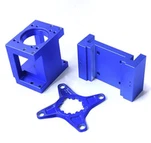
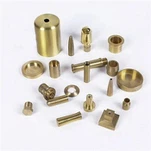
Hardware Machined Parts (五金加工零件)
What Are Hardware Machined Parts?
Hardware machined parts - also called metal precision parts or hardware components - refer to small to medium-sized mechanical parts manufactured from metal materials (or sometimes engineering plastics) through processes such as cutting, stamping, forging, and surface treatment. They serve as essential components in machinery, electronics, automobiles, medical devices, and consumer products.
Common Materials
Carbon steel / alloy steel – high strength, economical; often plated or heat-treated (e.g., 45# steel, 40Cr)
Stainless steel – corrosion resistance, clean appearance (e.g., 304, 316, 17-4PH)
Aluminum alloys – lightweight, good machinability, natural oxidation finish (e.g., 6061, 7075)
Copper & brass – excellent electrical/thermal conductivity (e.g., H62 brass, C1100 copper)
Titanium alloy – high strength-to-weight ratio, biocompatible for medical use
Main Manufacturing Processes
| Process | Description | Typical Parts |
|---|
| CNC turning | Parts rotated against a cutting tool on a lathe | Shafts, pins, screws, bushings, threaded parts |
| CNC milling | Rotating cutter removes material from a fixed workpiece | Housings, brackets, plates, grooves, complex 3D shapes |
| Stamping | Sheet metal formed/punched by dies in presses | Washers, clips, connectors, brackets |
| Drilling & tapping | Hole making and internal thread forming | Mounting holes, threaded holes |
| Grinding | High-precision finishing with abrasive wheels | Precision shafts, gauge parts |
| EDM / wire cutting | Electrical discharge machining for hard materials or fine slots | Molds, fine slots, special contours |
Common Types of Hardware Parts
Fasteners – screws, bolts, nuts, washers, rivets
Shaft parts – pins, spindles, dowels, hinge pins
Structural parts – brackets, frames, housings, flanges
Precision functional parts – gears, bushings, sleeves, terminals, connectors
Custom parts – non-standard components produced according to customer drawings
Typical Production Flow
Drawing review & DFM analysis – verify tolerances, materials, and process feasibility
Material preparation – bar stock, sheet metal, or forged blanks
Machining – turning, milling, drilling, tapping on CNC machines
Secondary processing – heat treatment (hardening, tempering), surface treatment (anodizing, plating, blackening, passivation, powder coating, polishing)
Quality inspection – CMM (coordinate measuring machine), 2D projector, calipers, thread gauges, hardness testers
Cleaning, packaging & delivery
Key Quality Requirements
Dimensional accuracy – tolerances typically ±0.01–0.1 mm; precision parts down to ±0.005 mm
Surface finish – Ra 0.8–3.2 μm for general parts; Ra 0.2–0.8 μm for precision or sealing parts
Positional accuracy – concentricity, perpendicularity, parallelism per GD&T drawings
Material certification – material test reports (MTC), RoHS/REACH compliance when required
Application Industries
Hardware machined parts are everywhere: automotive (connectors, brackets, sensors parts), electronics & communications (heat sinks, terminals, housings), medical devices (surgical components, instrument parts), machinery & automation (jig and fixture components, robotic parts), and aerospace & defense (high-precision structural parts).
Advantages of Custom Hardware Machining
Flexibility – suitable for single prototypes, small batches, or mass production
Precision – CNC machining ensures consistent, repeatable accuracy
Material diversity – almost any engineering metal can be processed
Fast turnaround – modern CNC shops can deliver samples in days