What Is Custom (Non-Standard) Parts Machining?
Definition
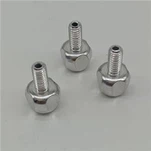
Custom parts machining-also called non-standard or bespoke machining-is the manufacture of components whose geometry, material, tolerance or finish requirements fall outside any published national or international standard (ISO, DIN, ANSI, JIS, GB, etc.). Every dimension, thread form, under-cut, coating call-out and inspection method is defined by the customer's unique drawing or 3-D model, not by a catalogue page.
Key Characteristics
One-off to Low-Volume
Lot sizes range from a single piece (prototype, jig, replacement) to a few hundred (special-purpose machinery, research hardware). Economies of scale typical of standard bolts or bearings rarely apply.
Design Freedom
Engineers can specify 30 mm-long M4 × 0.35 micro-threads on Ti-6Al-4V, 0.2 mm internal cooling channels, or ±3 µm concentricity between seven stepped diameters-features impossible to buy off the shelf.
Material Breadth
From oxygen-free copper to tungsten, PEEK, technical ceramics or Inconel 718, the choice is driven by function (thermal conductivity, bio-compatibility, wear resistance) rather than commodity availability.
Tight Tolerances & Special Finishes
Custom does not automatically mean "loose." Many non-standard parts still hold ±5 µm dimensional bands, 0.1 µm Ra mirror surfaces, or sub-micron roundness for optical housings and vacuum chambers.
Rapid Iteration
Because no inventory of standard sizes exists, design changes can be uploaded to the CAM station overnight and a revised part shipped in 24–72 h-critical for R&D and time-to-market races.
Typical Manufacturing Techniques
• 3-, 4- and 5-axis CNC milling & turning
• Swiss-type lathes for slender, high-aspect-ratio pins
• Wire/sinker EDM for sharp internal corners (<0.05 mm R)
• 5-axis simultaneous machining of contoured turbine blades or impellers
• Laser cladding or HSM for additive–subtractive hybrid features
• Precision grinding, honing and lapping for sub-µm finishes
Industries That Rely on Custom Parts
Aerospace (flight-qualified brackets), medical (patient-specific implants), semiconductor (wafer-handling end-effectors), energy (downhole logging tools), robotics (zero-backlash cycloid discs), automotive motorsports (billet throttle bodies), scientific instruments (vacuum chamber flanges) and even high-end consumer products (ergonomic keyboard frames).
Economic Model
Unit cost is higher than catalog hardware, but total cost of ownership often drops because the part fits the exact mechanical envelope, eliminates secondary assembly steps and reduces field failures. Modern quotation portals, automated CAM and lights-out machining have compressed lead-times and narrowed the price gap versus mass-produced equivalents.