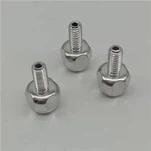
Precision machining requires a meticulous approach to ensure that components meet exacting specifications. The treatment methods involved in precision machining are designed to achieve high levels of accuracy, surface finish, and dimensional stability. Here's an overview of some common treatment methods used in precision machining:
Lubrication: Proper lubrication is essential to reduce friction between the tool and the workpiece, which minimizes heat generation and prevents damage to the workpiece. It also helps in extending tool life and improving the surface finish of the machined part.
Cooling: Cooling methods are employed to manage the heat generated during machining. This can involve the use of coolants that are either flood-fed or misted onto the cutting area. Effective cooling prevents thermal distortion and maintains the dimensional integrity of the workpiece.
Material Selection: Choosing the right material for the workpiece is crucial. Different materials have varying machinability properties, and selecting the appropriate material ensures that the machining process can achieve the desired outcome without excessive tool wear or part failure.
Tool Selection and Sharpening: The choice of cutting tools and their maintenance are critical in precision machining. Using sharp, well-maintained tools leads to cleaner cuts, less material distortion, and more accurate dimensions.
Cutting Parameters: Careful selection of cutting parameters, such as speed, feed rate, and depth of cut, is necessary to achieve precision. These parameters must be optimized to balance material removal, surface finish, and tool life.
Precision Grinding: This is a common method used to achieve very fine surface finishes and tight tolerances. Grinding involves the use of an abrasive wheel to remove a small amount of material from the workpiece surface.
Lapping and Polishing: These finishing techniques are used to achieve a high degree of surface flatness and smoothness. Lapping uses a soft, abrasive material to rub the workpiece surface, while polishing employs finer abrasives or polishing compounds to achieve a mirror-like finish.
Heat Treatment: Some precision machining processes may involve heat treatment to alter the physical properties of the workpiece material. Heat treatment can improve hardness, strength, and other mechanical properties of the material.
Inspection and Quality Control: Throughout the precision machining process, various inspection techniques are used to ensure that the parts meet the required specifications. This can include the use of measuring instruments like micrometers, calipers, and coordinate measuring machines (CMMs).
Surface Treatments: To enhance the durability and performance of the machined parts, various surface treatments may be applied, such as anodizing, plating, or coating. These treatments can improve corrosion resistance, wear resistance, and other surface properties.
By employing these treatment methods, precision machining can produce components with the high level of accuracy and quality required for demanding applications across various industries.