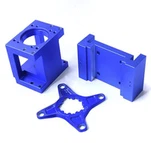
Milling is a versatile machining process that uses a rotating multi-toothed cutter, known as a milling tool or mill, to remove material from a workpiece. Here's an introduction to milling in English:
Milling is a cutting process that is used to shape, finish, and machine various materials, typically metals, by removing material in the form of small chips. The process is performed with a milling machine, which contains a spinning cutter that has a multitude of cutting edges or teeth arranged in a specific pattern on its surface. The milling cutter is旋转 to perform various operations, including but not limited to:
Surface Milling: This is the most common type of milling, where the cutter removes material to create a flat surface on the workpiece.
Peripheral Milling: In this process, the outer edges of the milling cutter engage the workpiece to perform the cut.
End Milling: The end face of the milling cutter is used to machine the workpiece, which is useful for making slots or pockets.
Slotting: Milling operations that create a narrow groove or slot in the workpiece.
Face Milling: Similar to surface milling, but specifically used to create a flat surface on the end of a workpiece.
Form Milling: Creating complex shapes or contours on the workpiece by using a shaped milling cutter.
Helical Milling: A specialized form of milling where the cutter has a helical (spiral) path, which can be used for cutting threads or helical grooves.
Straddle Milling: Milling a workpiece that is wider than the cutter, requiring the cutter to make multiple passes to complete the operation.
The milling process offers several advantages, such as:
Versatility: Milling machines can perform a wide range of operations, making them highly versatile.
Precision: With the right setup and tooling, milling can achieve high levels of precision and accuracy.
Efficiency: Milling can remove material quickly, which is efficient for high-volume production.
Complex Shapes: It is capable of producing complex geometries that might be difficult or impossible to create with other machining methods.
Milling machines can be manually operated or controlled by computers (CNC milling), which allows for greater precision and the ability to machine more complex parts. The milling process is essential in various industries, including automotive, aerospace,模具 manufacturing, and more, for the production of parts such as gears, turbines, dies, and molds.
In summary, milling is an indispensable machining method that uses a rotating cutter to remove material from a workpiece and create a desired shape or feature. Its wide range of applications and capabilities make it a cornerstone of modern manufacturing.