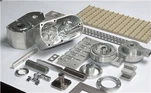
The Diversity of Material Choice for Non-Standard Metal Parts
Why "non-standard" also means "non-standard material"
When a part is not bound by any catalog specification, the alloy itself becomes a design variable. Engineers can therefore select from more than 300 wrought, cast and additive-ready metals to balance strength-to-weight, corrosion resistance, thermal/electrical behaviour, bio-compatibility, machinability and unit cost.
The "short list" that covers 90 % of custom jobs
The Diversity of Material Selection for Nonstandard Metal Parts
| Family | Typical Alloys | Key Properties | Custom Part Examples |
|---|---|---|---|
| Aluminium | 6061-T6, 7075-T6, 5083-H321, AlSi10Mg (AM) | Light, 170–530 MPa UTS, excellent machinability & thermal conductivity | UAV brackets, EV battery cooling plates, optical stages |
| Titanium | Grade 2 (CP), Grade 5 (Ti-6Al-4V), Ti-6Al-4V ELI | 900 MPa UTS, ρ = 4.5 g cm⁻³, biocompatible, 300 °C service | Surgical rasps, aerospace flap tracks, down-hole logging tools |
| Stainless & PH steels | 304L, 316L, 17-4 PH, 15-5 PH | Corrosion resistant, 17-4 PH reaches 40 HRC after 480 °C ageing | Food-grade valves, mould inserts, marine sensor housings |
| Ni-based super-alloys | Inconel 718, 625, Hastelloy C-276 | 700–1200 MPa, creep > 650 °C, oxidation & chloride resistant | Turbine swirlers, sub-sea couplings, chemical reactor baffles |
| Copper alloys | OFHC Cu, Cu-Cr-Zr, C17200 Be-Cu, Cu-Ni-Si | σ > 500 MPa, IACS ≥ 80 %, non-sparking | RF wave-guides, resistance-welding electrodes, bus-bars |
| Low-alloy & tool steels | 4140 QT, 4340, H13, D2, M2 | 28–62 HRC range, tough or wear-resistant | Gears, shafts, punches, plastic-injection cores |
| Magnesium | AZ91D (cast), AZ31B (wrought), WE43 (rare-earth) | ρ = 1.8 g cm⁻³, EMI shielding, machine dry | Drone arms, aerospace instrument panels |
| Refractory & specialty | Mo, W, Ta, Zr, Nb | Very high melting point, X-ray opacity | Furnace electrodes, sputter targets, cancer-treatment collimators |
| Metal-matrix composites | Al-SiC (35 %), Cu-W, Al-Diamond | Tailored CTE, 200–600 W m⁻¹ K⁻¹ | IGBT cold-plates, satellite heat spreaders |
| Amorphous & HEA | Zr-based BMG, CoCrFeMnNi | 2 GPa yield, net-shape casting possible | Luxury watch cases, micro-gears with 5 µm teeth |
Selection methodology (30-minute version)
List limit-states: σmax, Tmax, fatigue life, galvanic couple, FDA/USP, REACH, RoHS.
Rank by ρ/UTS, κ (thermal cond.), CTE and machinability index (1–10).
Eliminate alloys that fail any "go/no-go" gate (e.g., 316L cannot reach 45 HRC).
Run weighted decision matrix (cost × 30 %, mass × 25 %, lead-time × 20 %, corrosion × 15 %, machinability × 10 %).
Validate with 100 g pilot melt or additive cube → tensile & microstructure check.
Machinability vs. property trade-offs
Free-cutting brass CuZn39Pb3 gives 1.5× faster drilling than 6061, but UTS is only 380 MPa.
Ti-6Al-4V eats carbide at 30 mm/min; switching to high-pressure coolant (10 MPa) raises speed to 90 mm/min with 3× tool life.
Inconel 718 needs ceramic turning at 200 m/min; coated carbide would soften above 600 °C cutting zone.
Sustainability & recycling angles
6061 and 316L scrap returns > 95 % of raw value; Be-Cu and Ni-based revert still fetch 70 %.
Additive manufacturing lowers buy-to-fly from 15:1 (Inconel hog-out) to 1.2:1, saving 40 kg CO₂ per kg of part.
New low-carbon aluminium (Elysis, 2 t CO₂/t Al) is already requested by European automotive OEMs for custom housings.
Mini case studies
Case 1 – Light-weight corrosion-free robot arm
Requirement: 200 MPa yield, < 2.6 g cm⁻³, weldable, anodisable.
Decision: 7075-T6 replaced by Al-Li 2195 (ρ 2.63 g cm⁻³, UTS 455 MPa), saving 8 % mass and matching CTE of carbon-fibre tube.
Case 2 – High-heat-flux satellite amplifier
Need: 400 W heat load, CTE 6–8 ppm °C⁻¹, space-qualified.
Decision: Al-SiC 35 % MMC, diamond-turned to Ra 20 nm, eliminates CTE mismatch with GaN chip.
Case 3 – Disposable biopsy punch
Need: < 0.5 €, 52 HRC edge, sterilisable, 0.3 mm wall.
Decision: 420 stainless stamped & vacuum hardened; martensitic structure gives 800 MPa with 30 µm burr-free edge.
Future materials entering the non-standard arena
High-entropy alloys (CoCrFeMnNi) with cast + CNC route for hip stems.
Graphene-reinforced copper (0.1 wt %) giving 30 % higher IACS for EV bus-bars.
Amorphous steel ribbons laser-welded into net-shape gears, then 5-axis finished to 5 µm accuracy.
Take-away
Because every non-standard part starts with a blank drawing, the material list is limited only by physics and economics, not by catalogue pages. Mastering this diversity-knowing that 6061, Ti-6Al-4V or Cu-Cr-Zr is only the first question-turns custom metalworking into a competitive design weapon rather than a procurement inconvenience.