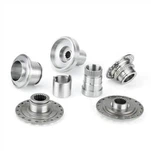
A CNC (Computer Numerical Control) parts machining center is a state-of-the-art facility where various types of machine tools are employed to manufacture parts with high precision and complexity. These centers are integral to modern manufacturing and cater to a wide range of industries, including automotive, aerospace, medical, and consumer electronics. Here's an introduction to what a CNC parts machining center entails:
What is a CNC Machining Center?
A CNC machining center is an advanced manufacturing cell that houses multiple CNC machines under one roof. These machines are computer-controlled and can perform a variety of operations, such as milling, turning, drilling, and boring, to produce precision parts from a range of materials.
Key Components of a CNC Machining Center:
CNC Machines: These include CNC lathes, milling machines, and multi-functional machines that can perform multiple operations like turning and milling in a single setup.
CAD/CAM Software: Computer-Aided Design (CAD) and Computer-Aided Manufacturing (CAM) software are used to design parts and generate the code necessary for the CNC machines to produce them.
Work-Holding Devices: These are fixtures that securely hold the workpiece in place during the machining process.
Tooling: A wide range of cutting tools are used, each designed for specific operations.
Inspection Equipment: Precision measuring tools and Coordinate Measuring Machines (CMMs) are used to ensure parts meet the required specifications.
Material Storage: The center has storage for raw materials, which can include various types of metals, plastics, and composites.
Operator Workstations: Spaces for machinists to program the machines, monitor the machining process, and perform quality checks.
Operations Performed at a CNC Machining Center:
Turning: Rotating the workpiece while a cutting tool moves linearly to create symmetrical parts.
Milling: Using a multi-toothed cutter to remove material from the workpiece, suitable for complex shapes.
Drilling: Creating holes in the workpiece with a rotating cutting tool.
Tapping and Threading: Cutting internal and external threads in a workpiece.
Grinding: A finishing operation that uses an abrasive wheel to achieve a fine surface finish and tight tolerances.
Multi-Axis Machining: Performing multiple operations on different faces of a workpiece in a single setup.
Benefits of a CNC Machining Center:
Precision: CNC machines can produce parts with very tight tolerances, ensuring accuracy and repeatability.
Efficiency: Automated processes reduce production times and minimize the need for manual intervention.
Complexity: Capable of producing parts with complex geometries that would be difficult or impossible to achieve with manual machining.
Cost-Effectiveness: While the initial investment in CNC machinery can be high, the reduced labor costs and increased efficiency can make it more cost-effective for large production runs.
Flexibility: CNC machines can be quickly reprogrammed to produce different parts, offering greater flexibility in production.
Industries Served by CNC Machining Centers:
Aerospace: For the production of high-precision components with tight tolerances.
Automotive: For manufacturing engine parts, chassis components, and other intricate parts.
Medical: For creating prosthetics, surgical instruments, and other precision medical devices.
Defense: For the production of high-precision components for military applications.
Consumer Electronics: For manufacturing parts for smartphones, computers, and other electronic devices.
A CNC parts machining center is a hub of advanced manufacturing technology, capable of producing a wide range of precision parts efficiently and accurately. As technology continues to evolve, the capabilities of these centers are expected to expand, further enhancing their role in the production of high-quality components.