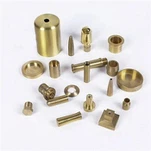
Custom Precision Hardware Machining: Key Factors for Choosing a Professional Partner
Clarify "Non-Standard" Up-Front
Create a one-page specification pack that lists special geometries (deep internal under-cuts, 0.2 mm wall thickness, 30:1 L/D micro-holes), one-off or low-volume demand (<500 pcs/yr), exotic alloys (Inconel 718, Ti-6Al-4V, beryllium copper) and post-processes (PVD, passivation, black-oxide). A professional shop will return red-lined drawings showing DF®M changes and tooling suggestions within 48 h-proof they treat custom work as engineering, not just machining .
Verify Micro-Tolerance Track Record
Ask to see CMM reports of previous non-standard jobs where CpK ≥ 1.33 was held on tolerances ≤ ±0.01 mm. View the actual measured-versus-nominal data; glossy brochures are meaningless. Shops that diamond-turn 0.5 µm true-position holes daily will have the inspection data on their server.
Demand One-Stop Capability
Custom hardware often needs wire-EDM for square corners, 5-axis milling for compound angles, and laser welding for dissimilar metals. A partner that performs all processes in-house eliminates re-fixturing errors and cuts lead-time 30 %. Make sure they also own anodizing, plating or heat-treat furnaces so your part never leaves the building for "mystery" outsourcing.
Insist on Material & Heat-Lot Traceability
Non-standard parts are frequently safety-critical. Request EN 10204 3.1 certificates for every bar; the supplier should be able to link the serial number on your part back to the original mill test in minutes. If they hesitate, walk away-traceability is non-negotiable in aerospace, medical and energy markets.
Check Rapid-Proto ↔ Production Scalability
Your concept may start with 5 prototypes but ramp to 3 000 pcs/yr. Ask to see the same CAM program used for both phases and a capacity chart showing monthly spindle hours reserved for overflow. Providers that can't show a seamless transition will quote you a dreamy prototype price and then hit you with 80 % increases once you scale.
Evaluate Responsive Engineering Support
A true custom partner assigns a named project engineer who replies within 4 h and speaks fluent English (or your language). During the first call they should question datum structure, suggest tolerance relaxation and propose standard tooling that saves 15 % cycle time-clear evidence they care about your total cost, not just the PO value.
Audit Certifications Aligned to Your Risk
ISO 9001 is the minimum; if the hardware flies, implants or goes sub-sea you need AS9100, ISO 13485 or NORSOK compliance. Ask for the latest external audit report-any open non-conformities must be closed with root-cause evidence.
Secure Transparent, Itemised Quotes
Custom jobs often involve special cutters, custom fixtures and small-batch anodising baths. The quotation should list every cost element (material, set-up, tool wear, coating, freight). Hidden extras are the first sign a supplier has not understood the complexity of non-standard hardware.
Validate Logistics & After-Sales Policy
Non-standard parts are useless if they arrive late. Demand a 98 % on-time-delivery KPI written into the contract, plus a 30-day no-questions-asked replacement policy for any out-of-spec part. The best houses provide air-shipments at their own expense when they miss the dock date .
Follow these nine checkpoints and you convert the high-risk world of custom precision hardware into a predictable extension of your own engineering team.