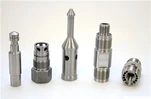
Introduction to High Precision CNC Parts Machining
High precision CNC (Computer Numerical Control) machining is an advanced manufacturing process that utilizes computer-controlled machines to produce parts with exceptional accuracy and repeatability. This method is vital for industries where precision is critical, such as aerospace, medical, automotive, and electronics.
Key Features of High Precision CNC Machining:
Accuracy: High precision CNC machining can achieve tolerances within a few microns, ensuring parts meet stringent specifications.
Complexity: It can handle complex geometries and intricate designs that are not feasible with manual machining.
Efficiency: Automated processes reduce production time and labor costs, making it efficient for both small and large production runs.
Material Compatibility: CNC machines can work with a variety of materials, including metals, plastics, and composites.
Repeatability: The ability to produce identical parts time and time again is crucial for maintaining consistency in quality.
Customization: Offers the flexibility to create custom parts tailored to specific design requirements.
Process Steps in High Precision CNC Machining:
Design: The part is designed using CAD (Computer-Aided Design) software, creating a detailed 3D model.
CAM Programming: The CAD model is converted into a toolpath using CAM (Computer-Aided Manufacturing) software, which generates the instructions for the CNC machine.
Setup: The workpiece is securely mounted in the CNC machine, and the appropriate cutting tools are selected.
Machining: The CNC machine follows the programmed toolpath to remove material from the workpiece, forming the part with high precision.
Inspection: After machining, parts are inspected using precision measurement tools such as CMMs (Coordinate Measuring Machines) to ensure they meet the required tolerances.
Finishing: Additional operations such as deburring, polishing, or heat treatment may be performed to achieve the desired surface finish and properties.
Advantages of High Precision CNC Machining:
Reduced Scrap Rate: With high precision, the likelihood of producing scrap parts is minimized.
Improved Product Quality: Consistently high-quality parts are produced due to the controlled machining environment.
Faster Prototyping: Rapid creation of prototypes for testing and design validation.
Cost-Effective for Complex Parts: Often more cost-effective than traditional manufacturing methods for complex parts.
Increased Productivity: Automated processes and reduced setup times lead to higher productivity.
Applications of High Precision CNC Maching:
Aerospace Components: Precision parts for engines, landing gear, and flight control systems.
Medical Devices: High-precision components for prosthetics, surgical instruments, and diagnostic equipment.
Automotive Industry: Precision parts for engines, transmissions, and high-performance vehicle components.
Electronics: Precision parts for electronic devices, including connectors, casings, and circuit boards.
Watchmaking: Tiny, intricate components for high-precision timepieces.
Conclusion:
High precision CNC machining is a cornerstone of modern manufacturing, providing the means to produce parts with exceptional accuracy and quality. As technology continues to advance, the capabilities of CNC machining are expanding, allowing for even greater precision and complexity in the parts that can be manufactured. This advancement is crucial for industries that rely on high-performance components and is driving innovation in product design and manufacturing processes.