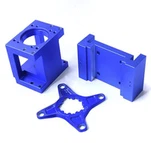
Advantages and Characteristics of Turn-Mill Composite Machining
1. Process Integration & Reduced Setup Times
Complete Machining in One Clamping: Turn-mill centers combine turning and milling operations, allowing complex parts to be fully machined in a single setup without transferring between lathes and milling machines.
Elimination of Multiple Setups: Reduces part handling, fixture changes, and manual repositioning, significantly decreasing non-cutting time and total production lead time.
Improved Datum Consistency: Maintaining a single workpiece coordinate system throughout machining eliminates datum shift errors and improves geometric accuracy.
2. Enhanced Geometric Accuracy
Single Reference Frame: Since the workpiece remains fixtured throughout all operations, accumulated positioning errors from multiple setups are eliminated.
Superior Concentricity & Perpendicularity: Features such as turned diameters, milled flats, drilled holes, and threaded surfaces achieve tighter relative positional tolerances.
Reduced Form Errors: Continuous machining without reclamping minimizes elastic deformation and clamping-induced distortion.
3. Expanded Machining Capabilities
Complex Geometry Production: Capable of generating intricate features including eccentric turning, off-center milling, polygonal profiles, cam contours, and helical grooves that are difficult or impossible on conventional single-process machines.
5-Axis Simultaneous Machining: Advanced turn-mill centers with B-axis milling spindles and Y-axis travel enable full 5-axis interpolation for sculptured surfaces and undercut features.
Power Skiving & Gear Hobbing: Some systems integrate gear cutting capabilities, allowing complete powertrain components to be produced on one platform.
4. Increased Productivity & Throughput
Parallel Processing: Main and sub-spindle configurations enable front/back-side simultaneous machining; upper/lower turrets perform concurrent operations.
Unattended Operation: Integration with bar feeders, gantry loaders, and robotic part handling supports continuous lights-out manufacturing.
Optimized Tool Utilization: Shared tool magazines for both turning and milling operations reduce redundant tooling and tool change cycles.
5. Superior Surface Quality & Chip Control
Optimal Tool Orientation: The milling spindle can approach the workpiece at the ideal angle for each feature, improving surface finish and extending tool life.
Continuous Chip Management: Turning produces manageable chips; milling strategies can be selected to prevent chip nesting in complex internal geometries.
Thermal Stability: Reduced setup changes mean fewer thermal transients; consistent coolant application maintains stable cutting temperatures.
6. Flexibility for Low-Volume & High-Mix Production
Quick Changeover: Modern turn-mill centers with automatic tool changers and program-driven fixture adaptation excel in small-batch, high-variety manufacturing environments.
Reduced Fixture Inventory: Fewer dedicated fixtures are needed when one machine handles multiple operations, lowering capital investment and storage requirements.
Rapid Prototyping: Designers can iterate complex parts faster when process planning is consolidated onto a single platform.
7. Economic & Competitive Advantages
Lower Labor Costs: Reduced operator intervention and simplified workflow decrease direct labor requirements per part.
Decreased Work-in-Progress (WIP): Parts move through production faster with fewer intermediate queues between operations.
Capital Efficiency: One turn-mill center replaces multiple conventional machines, reducing floor space, maintenance overhead, and energy consumption.
Shortened Time-to-Market: Faster production cycles and streamlined quality validation accelerate product launch schedules.
8. Advanced Control & Intelligence Features
Synchronized Spindle Control: Precise synchronization between main spindle and live tooling enables high-precision thread milling, polygon turning, and whirling operations.
Real-Time Process Monitoring: Integrated sensors for tool wear, vibration, and dimensional verification support adaptive machining and predictive maintenance.
CAD/CAM Integration: Seamless programming environments (such as ESPRIT, GibbsCAM, or Siemens NX) optimize tool paths for mill-turn kinematics and collision avoidance.
Summary
表格
| Aspect | Conventional Separate Processes | Turn-Mill Composite Machining |
|---|---|---|
| Setup Count | Multiple | Single |
| Accuracy | Accumulated errors | High precision |
| Flexibility | Limited by machine type | Multi-process capable |
| Lead Time | Longer (queue + transfer) | Shorter |
| Floor Space | Multiple machines required | Compact |
| Automation | Complex integration | Streamlined |
Turn-mill composite machining represents a paradigm shift from traditional process-oriented manufacturing to part-oriented complete machining. It is particularly advantageous for aerospace components, medical implants, automotive powertrain parts, hydraulic manifolds, and precision instrument housings-where geometric complexity, tight tolerances, and production efficiency are simultaneously critical.