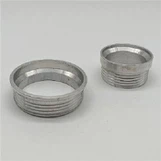
The thermal conductivity of materials plays a crucial role in various engineering and manufacturing applications. When it comes to custom titanium parts, understanding their thermal conductivity is essential for ensuring optimal performance in different environments. As a trusted supplier of custom titanium parts, I have witnessed firsthand the significance of this property in meeting the diverse needs of our clients. In this blog post, I will delve into the topic of the thermal conductivity of custom titanium parts, exploring its importance, factors that influence it, and how it impacts the performance of these parts.
Understanding Thermal Conductivity
Thermal conductivity is a measure of a material's ability to conduct heat. It is defined as the quantity of heat transmitted through a unit thickness of a material in a direction normal to a surface of unit area, due to a unit temperature gradient under steady-state conditions. In simpler terms, it indicates how easily heat can pass through a material. Materials with high thermal conductivity, such as metals like copper and aluminum, transfer heat quickly, while those with low thermal conductivity, like plastics and ceramics, are better insulators.
Thermal Conductivity of Titanium
Titanium is a metal known for its exceptional strength, low density, and excellent corrosion resistance. However, compared to some other common metals, titanium has relatively low thermal conductivity. The thermal conductivity of pure titanium at room temperature is approximately 21.9 W/(m·K) [1]. This value is significantly lower than that of copper (about 401 W/(m·K)) and aluminum (about 237 W/(m·K)) [2].
The low thermal conductivity of titanium can be attributed to its crystal structure and electronic properties. Titanium has a hexagonal close-packed (HCP) crystal structure, which restricts the movement of heat-carrying electrons. Additionally, the presence of impurities and alloying elements can further reduce the thermal conductivity of titanium.
Factors Influencing the Thermal Conductivity of Custom Titanium Parts
While the base thermal conductivity of titanium is relatively low, several factors can influence the thermal conductivity of custom titanium parts. These factors include:
Alloy Composition
Most custom titanium parts are made from titanium alloys rather than pure titanium. Alloying elements are added to titanium to enhance its mechanical properties, such as strength and hardness. However, these alloying elements can also affect the thermal conductivity of the material. For example, the addition of aluminum and vanadium in the popular Ti-6Al-4V alloy can slightly reduce its thermal conductivity compared to pure titanium [3].
Microstructure
The microstructure of titanium parts, which is determined by factors such as the manufacturing process and heat treatment, can also impact thermal conductivity. A fine-grained microstructure generally has lower thermal conductivity than a coarse-grained one. This is because grain boundaries act as barriers to the movement of heat-carrying electrons.
Temperature
The thermal conductivity of titanium is temperature-dependent. As the temperature increases, the thermal conductivity of titanium generally decreases. This is due to the increased scattering of electrons and phonons (lattice vibrations) at higher temperatures.
Manufacturing Process
The manufacturing process used to produce custom titanium parts can also affect their thermal conductivity. Processes such as forging, machining, and welding can introduce residual stresses and microstructural changes in the material, which can influence its thermal conductivity. For example, machining operations can create a work-hardened layer on the surface of the part, which may have different thermal properties compared to the bulk material.
Importance of Thermal Conductivity in Custom Titanium Parts
The thermal conductivity of custom titanium parts is an important consideration in many applications. Here are some examples:
Aerospace Applications
In the aerospace industry, titanium parts are widely used due to their high strength-to-weight ratio and corrosion resistance. However, in applications where heat transfer is critical, such as in engine components and heat exchangers, the low thermal conductivity of titanium can be a challenge. Engineers need to carefully design these parts to ensure efficient heat dissipation. For instance, fins or other heat transfer enhancement features can be added to increase the surface area available for heat transfer.
Medical Applications
Titanium is a popular material in medical applications, such as orthopedic implants and dental prosthetics, due to its biocompatibility and mechanical properties. In some medical devices, such as heat-activated drug delivery systems, the thermal conductivity of titanium can affect the rate of drug release. Understanding the thermal conductivity of custom titanium parts is crucial for optimizing the performance of these devices.
Automotive Applications
In the automotive industry, titanium parts are used in high-performance engines and exhaust systems. The low thermal conductivity of titanium can help reduce heat transfer to other components, improving the overall efficiency and durability of the engine. However, in applications where rapid heat dissipation is required, such as in brake calipers, additional cooling measures may be necessary.
How Our Custom Titanium Parts Address Thermal Conductivity Challenges
As a supplier of custom titanium parts, we understand the importance of thermal conductivity in different applications. We work closely with our clients to ensure that our parts meet their specific requirements. Here's how we address thermal conductivity challenges:
Material Selection
We offer a wide range of titanium alloys, each with its own unique combination of properties, including thermal conductivity. Our experienced engineers can help clients select the most suitable alloy for their application based on factors such as the required strength, corrosion resistance, and thermal conductivity.
Design Optimization
We use advanced design and simulation tools to optimize the design of our custom titanium parts for efficient heat transfer. This may involve adding features such as fins, channels, or heat pipes to enhance the thermal performance of the parts.
Manufacturing Process Control
We have strict quality control measures in place to ensure that our manufacturing processes do not negatively impact the thermal conductivity of our parts. We carefully control parameters such as temperature, pressure, and machining speed to minimize the introduction of residual stresses and microstructural changes that could affect thermal conductivity.
Conclusion
The thermal conductivity of custom titanium parts is an important property that can significantly impact their performance in various applications. While titanium has relatively low thermal conductivity compared to some other metals, understanding the factors that influence it and taking appropriate measures to address thermal conductivity challenges can help ensure the optimal performance of these parts.


If you are in need of custom titanium parts and have specific thermal conductivity requirements, we would be delighted to assist you. Our team of experts can work with you to design and manufacture high-quality titanium parts that meet your exact specifications. Whether you need Titanium CNC Turning Parts or Titanium CNC Milling Parts, we have the capabilities and experience to deliver. Contact us today to discuss your project and explore how our custom titanium parts can meet your needs.
References
[1] "Thermal Conductivity of Metals." Engineering ToolBox.
[2] "Thermal Conductivity of Copper and Aluminum." MatWeb.
[3] "Thermal Properties of Titanium Alloys." ASM Handbook, Volume 2: Properties and Selection: Nonferrous Alloys and Special-Purpose Materials.