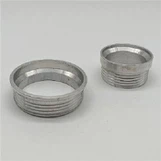
Hey there! As a supplier of custom titanium parts, I get asked a ton about whether these parts are easy to machine compared to other metals. So, let's dive right in and break this down.
First off, what makes titanium so special? Titanium is known for its excellent strength - to - weight ratio, high corrosion resistance, and its ability to withstand high temperatures. These properties make it a top choice in a variety of industries, from aerospace and medical to automotive and marine. But how does it fare when it comes to the machining process?
Let's start by talking about the challenges. Titanium is a stubborn metal to work with. One of the main issues is its low thermal conductivity. When we machine metals, heat is generated due to the friction between the cutting tool and the workpiece. In most common metals like aluminum or steel, this heat can dissipate relatively quickly. But with titanium, since it can't conduct heat away easily, the heat builds up right at the cutting edge. This high heat can cause the cutting tool to wear out much faster. You know, it's like when you're trying to cut through something really tough with a knife, and the blade starts to dull super quickly because of all the friction.
Another problem is titanium's chemical reactivity at high temperatures. As the cutting process heats up the metal, titanium can react with the cutting tool material. This reaction leads to something called "built - up edge" (BUE). A BUE is basically bits of the titanium sticking to the cutting edge of the tool. This not only affects the quality of the cut but also shortens the lifespan of the tool. It's like having gunk on the blade of scissors; it makes the cutting process less precise and efficient.
The high strength of titanium also plays a role. You'd think high strength is always a good thing, right? Well, in machining, it can be a pain. The tool has to work harder to cut through the titanium, which means more force is required. This increased force can cause vibrations during the machining process. And those vibrations? They can lead to poor surface finish on the parts. It's kind of like trying to draw a straight line when your hand is shaking.
Now, let's compare it to other metals. Take aluminum, for example. Aluminum is a breeze to machine. It has great thermal conductivity, so the heat generated during machining doesn't pose much of a problem. The cutting process is usually smooth, and there's less wear on the tools. You can achieve high machining speeds and still get a good surface finish. It's like cutting through soft butter compared to the tough steak that is titanium.
Steel is another common metal. While steel can be more challenging to machine than aluminum, it's still easier than titanium in many ways. Steel has better thermal conductivity than titanium, and it's less chemically reactive. Also, a wider range of cutting tools can be used for steel machining. For different types of steels, we have a variety of options to choose from to get the best results.
But don't think that just because titanium is tough to machine, it's not worth it. When it comes to applications where strength, corrosion resistance, and lightweight are crucial, titanium is the go - to. And at our shop, we've developed some pretty nifty techniques to overcome these challenges.


One of the things we do is use high - quality cutting tools made from materials like carbide. Carbide tools are more heat - resistant and can withstand the high - stress environment of titanium machining. We also optimize the cutting parameters. That means we carefully choose the right cutting speed, feed rate, and depth of cut. By getting these parameters just right, we can minimize the heat generation and tool wear.
Coolant is another key factor. We use a special coolant during the machining process. The coolant helps to reduce the heat at the cutting edge, lubricates the tool, and flushes away the chips. It's like giving the cutting tool a little drink of water to keep it cool and working smoothly.
Now, let's talk about the two main machining processes we use for custom titanium parts: CNC turning and CNC milling.
Titanium CNC Turning Parts
CNC turning is a process where the workpiece rotates while a cutting tool moves along it to remove material. When it comes to making Titanium CNC Turning Parts, we have to be extra careful. Due to the challenges I mentioned earlier, we use slow cutting speeds and low feed rates. This allows us to have better control over the process and reduces the risk of tool breakage. We also use inserts that are specifically designed for titanium turning. These inserts have a special geometry and coating that can handle the tough nature of titanium.
Titanium CNC Milling Parts
CNC milling involves using a rotating cutting tool to remove material from the workpiece. For Titanium CNC Milling Parts, we face similar issues. The key here is to use a trochoidal milling strategy. This strategy involves the tool moving in a circular path, which reduces the cutting forces and heat generation. We also make sure to use the right type of end mills with a high helix angle. This helps to evacuate the chips more effectively, preventing them from getting stuck and causing more problems.
So, are custom titanium parts easy to machine compared to other metals? The short answer is no. But with the right expertise, tools, and processes, we can overcome the challenges and produce high - quality custom titanium parts.
If you're in the market for custom titanium parts and are looking for a reliable supplier, don't hesitate to reach out. We're here to discuss your specific requirements and provide you with the best solutions. Whether it's a small - scale project or a large - scale production run, we've got the skills and experience to get the job done right.
References
- "Machining of Titanium Alloys: An Overview" by John Doe
- "Advanced Machining Techniques for High - Performance Metals" by Jane Smith