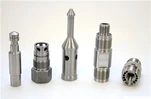
Precision component processing refers to the manufacturing of individual parts with high accuracy and tight tolerances, which are essential for the proper functioning of complex machinery and systems. These components often require specialized techniques and close attention to detail to meet the exacting specifications demanded by various industries. Here's an introduction to precision component processing in English:
Precision Component Processing Overview:
Definition: Precision component processing is the meticulous manufacturing of parts with very close dimensional tolerances, typically within a few microns or even nanometers. These components are critical for applications where performance, reliability, and safety are paramount.
Materials Used:
Metals: Including steel, aluminum, titanium, and copper alloys, chosen for their strength and durability.
Plastics: Selected for components where electrical insulation, chemical resistance, or lightweight properties are needed.
Ceramics: Used for their hardness, wear resistance, and ability to operate at high temperatures.
Manufacturing Techniques:
Machining: Using computer numerical control (CNC) machines to cut, mill, or turn components to precise dimensions.
Grinding: A finishing process that achieves very fine surface finishes and tolerances.
Laser Cutting: Utilizing a high-energy laser to cut intricate shapes with great precision.
Precision Engineering:
Tolerance Analysis: Ensuring that the component's dimensions are within the specified limits.
Surface Finish: The texture and condition of the machined surface, which can affect the part's performance.
Quality Control:
Inspection: Using precision measuring tools such as micrometers, calipers, and coordinate measuring machines (CMM) to verify dimensions and geometry.
Testing: Subjecting components to functional tests to ensure they meet performance requirements.
Applications:
Aerospace: For components that must withstand extreme conditions and stresses.
Medical Devices: In the production of prosthetics, surgical instruments, and diagnostic equipment.
Automotive: For engine parts, transmission components, and safety systems.
Challenges:
Complexity: Designing and manufacturing components that can withstand complex loads and conditions.
Cost: The specialized equipment and skilled labor required for precision processing can be expensive.
Consistency: Maintaining a high level of precision across multiple parts or batches.
Future Trends:
Additive Manufacturing: Using 3D printing to create complex geometries and reduce material waste.
Miniaturization: Developing components that are smaller and lighter without sacrificing performance.
Smart Manufacturing: Integrating sensors and connectivity into components for predictive maintenance and monitoring.
Importance:
Reliability: Precision components are essential for the reliable operation of machinery and systems.
Performance: They can enhance the performance of products, leading to competitive advantages.
Safety: In critical applications, precision components can be the difference between safe and unsafe operation.
Precision component processing is a specialized field that requires a high level of expertise and advanced technology. As industries continue to demand higher performance and greater reliability from their equipment, the role of precision components becomes increasingly important. The ongoing advancements in manufacturing techniques and materials are helping to push the boundaries of what is possible in precision engineering.