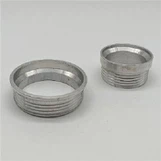
As a supplier of Titanium Seat Collar, ensuring the quality of our products is of utmost importance. In this blog post, I will share with you the comprehensive process I use to test the quality of a titanium seat collar. This knowledge not only helps us maintain high - quality standards but also gives our customers confidence in our products.
1. Material Inspection
The first step in testing the quality of a titanium seat collar is to inspect the raw material. Titanium is known for its excellent strength - to - weight ratio, corrosion resistance, and biocompatibility. However, the quality of titanium can vary significantly.
We source our titanium from trusted suppliers and conduct a series of tests on the incoming material. One of the most common tests is the chemical composition analysis. We use a spectrometer to determine the exact percentages of elements in the titanium. For a high - quality titanium seat collar, the titanium should have a high purity level, typically over 99%. Impurities such as iron, aluminum, and vanadium can affect the mechanical properties of the titanium. If the levels of these impurities are too high, the seat collar may be more prone to cracking or have reduced strength.
In addition to chemical composition, we also check the physical properties of the titanium. This includes measuring the density, hardness, and grain size. The density of pure titanium is around 4.5 g/cm³. Deviations from this value may indicate problems with the material. Hardness is measured using a hardness tester, and it should fall within a specific range to ensure the seat collar can withstand the stresses it will encounter during use. A proper grain size is also crucial as it affects the ductility and strength of the titanium. We use metallographic microscopy to examine the grain structure of the material.


2. Dimensional Accuracy
Dimensional accuracy is critical for a titanium seat collar. It must fit precisely on the bicycle frame and seat post to function properly. We use precision measuring tools such as calipers, micrometers, and coordinate measuring machines (CMM) to check the dimensions of the seat collar.
The inner diameter of the seat collar should match the outer diameter of the seat post within a very tight tolerance. Usually, the tolerance is within ±0.05 mm. Any deviation from this can cause the seat collar to either be too loose, resulting in the seat post slipping, or too tight, which may damage the seat post or make it difficult to adjust.
The width and height of the seat collar also need to be accurate. The width should be consistent along the entire length of the collar to ensure even clamping force. The height affects the stability of the seat post, and it should be within the specified range.
3. Surface Finish
A good surface finish not only enhances the appearance of the titanium seat collar but also affects its performance. We use a surface roughness tester to measure the smoothness of the surface. A smooth surface reduces friction between the seat collar and the seat post, making it easier to adjust the seat height.
We also check for any surface defects such as scratches, pits, or cracks. These defects can weaken the seat collar and may lead to failure under stress. To detect these defects, we use visual inspection methods, including magnifying glasses and bright - field illumination. If any surface defects are found, the seat collar is either re - worked or rejected.
4. Clamping Force Test
The clamping force is one of the most important performance indicators of a titanium seat collar. It determines how well the seat collar can hold the seat post in place. We use a specialized clamping force testing machine to measure the force required to loosen the seat post after it has been tightened by the seat collar.
The clamping force should be sufficient to prevent the seat post from slipping under normal riding conditions. However, it should not be so high that it damages the seat post. We conduct multiple tests with different seat post materials, such as carbon fiber and aluminum, as different materials have different properties and require different clamping forces.
5. Fatigue Testing
Bicycles are often subjected to repeated vibrations and shocks during use. Therefore, a titanium seat collar needs to be able to withstand fatigue. We use a fatigue testing machine to simulate the real - world conditions that the seat collar will encounter.
The fatigue testing machine applies a cyclic load to the seat collar for a specified number of cycles. The load is set to simulate the normal stresses that the seat collar will experience during riding. After the fatigue test, we inspect the seat collar for any signs of cracking or deformation. If the seat collar passes the fatigue test, it indicates that it has good durability and can be expected to have a long service life.
6. Corrosion Resistance Test
Titanium is known for its excellent corrosion resistance, but it is still important to test the seat collar to ensure it can withstand different environmental conditions. We use a salt spray test to simulate the effects of corrosion.
In the salt spray test, the seat collar is placed in a chamber filled with a salt - water mist. The test is run for a specific period, usually several hundred hours. After the test, we examine the seat collar for any signs of corrosion, such as rust or pitting. A high - quality titanium seat collar should show minimal signs of corrosion after the salt spray test.
Comparison with Other Materials
When considering the quality of a titanium seat collar, it is also useful to compare it with seat collars made from other materials, such as aluminum. You can find more information about Aluminum Seat Post Collar on our website. Aluminum seat collars are generally lighter and less expensive than titanium ones. However, they are also less strong and more prone to corrosion. Titanium seat collars offer a better balance between strength, weight, and corrosion resistance.
Another related product is the Bicycle Seatpost Clamp. While the basic function is similar to a seat collar, a seatpost clamp may have different designs and performance characteristics.
Conclusion
Testing the quality of a titanium seat collar is a multi - step process that involves inspecting the material, checking dimensional accuracy, evaluating surface finish, measuring clamping force, conducting fatigue and corrosion resistance tests. By following these rigorous testing procedures, we can ensure that our Titanium Seat Collar products meet the highest quality standards.
If you are interested in purchasing high - quality titanium seat collars, we invite you to contact us for further discussion. Our team of experts is ready to answer your questions and provide you with the best solutions for your needs.
References
- ASM Handbook Volume 2: Properties and Selection: Nonferrous Alloys and Special - Purpose Materials. ASM International.
- Bicycle Manufacturing and Design Standards. International Organization for Standardization (ISO).