Can I use hangers for ponchos? This is an interesting question that might seem a bit out of the ordinary at first glance. As a hanger supplier, I've been dealing with various types of hangers for different purposes, mainly in the context of bicycle parts. But let's explore the possibility of using hangers for ponchos from a scientific and practical perspective.
Understanding Hangers
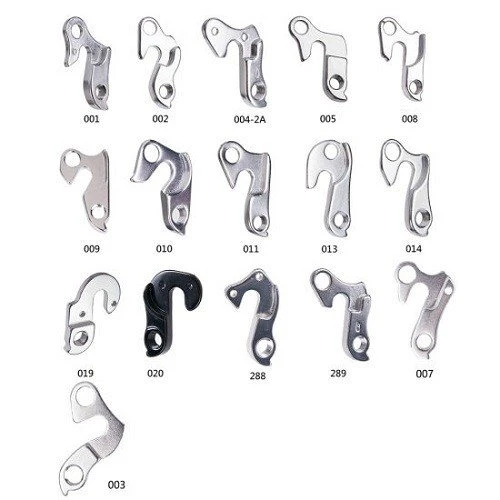
First, let's understand what hangers we are talking about. In my business, I supply a wide range of hangers, including UDH MTB Bike Rear Derailleur 1.0mm Pitch SRAM UDH Wholesale Batch Stock Rear Derailleur Hanger SRAM UDH Thru Axle Dropout, Titanium Hangers, and Aluminum Hangers. These hangers are primarily designed for bicycles, with specific functions such as supporting the rear derailleur, ensuring smooth gear - shifting, and maintaining the structural integrity of the bike frame.
The UDH MTB Bike Rear Derailleur hanger is made to precise specifications. It has a 1.0mm pitch, which is crucial for the proper alignment and operation of the SRAM UDH rear derailleur. Titanium hangers are known for their high strength - to - weight ratio, making them ideal for high - performance bicycles where weight reduction is a priority. Aluminum hangers, on the other hand, are more cost - effective and offer good corrosion resistance, making them a popular choice for a wide range of bicycles.
The Concept of Using Hangers for Ponchos
When considering using hangers for ponchos, we need to think about the properties of both hangers and ponchos. Ponchos are typically made of lightweight, waterproof materials, such as nylon or polyester. Their main purpose is to protect the wearer from rain or other elements. They are usually designed to be draped over the body and may have some form of closure or tie - down mechanism.
Hangers, as mentioned earlier, are designed for bicycles. However, in theory, some of their properties could potentially be useful for ponchos. For example, the shape and structure of a hanger could be used to create a support system for a poncho. If we take an aluminum hanger, its relatively lightweight and rigid structure could be bent or modified to form a frame that could hold a poncho in a more upright position, similar to a small tent or canopy.

Scientific Considerations
From a scientific perspective, we need to consider several factors. First is the material compatibility. Ponchos are made of soft, flexible materials, while hangers are made of metals like aluminum or titanium. The sharp edges of a hanger could potentially damage the poncho material if not properly padded or modified.
Another factor is the load - bearing capacity. A hanger is designed to support the weight of a bicycle rear derailleur and withstand the forces generated during cycling. When used for a poncho, the load - bearing requirements are different. The hanger needs to support the weight of the poncho itself and any additional forces such as wind resistance. If the hanger is not strong enough, it could bend or break under these forces.
The aerodynamics of the combined hanger - poncho system also need to be considered. A poorly designed hanger - poncho combination could create a lot of drag, which would be a problem, especially if the poncho is being used during activities like cycling or hiking.
Practical Applications
Let's explore some practical applications where using hangers for ponchos could be useful. One scenario could be for cyclists. A cyclist might want to use a poncho for protection from the rain, but the traditional way of wearing a poncho can be cumbersome and restrict movement. By using a modified hanger to create a support structure for the poncho, the cyclist could have a more streamlined and comfortable setup. The hanger could be attached to the bicycle frame in a way that the poncho is held above the cyclist, providing protection without interfering with pedaling or steering.
Another application could be for outdoor enthusiasts. When camping or hiking, a poncho can be used as a makeshift shelter. A hanger could be used to create a simple frame for the poncho, turning it into a small, lightweight tent. This could be especially useful in emergency situations where a more substantial shelter is not available.
Modification and Adaptation
To use hangers for ponchos effectively, some modification and adaptation are required. First, the sharp edges of the hanger need to be smoothed or padded to prevent damage to the poncho. This could be done by wrapping the hanger with a soft material such as foam or fabric.
The hanger also needs to be shaped to fit the poncho. This might involve bending the hanger into a suitable curve or angle. For example, if we want to create a canopy - like structure for a poncho, the hanger could be bent into a semicircular shape.
Attachment points are also crucial. The hanger needs to be attached to the poncho in a way that is secure but also allows for easy removal. Velcro strips or small clips could be used to attach the hanger to the poncho.
Limitations and Challenges
There are, of course, limitations and challenges to using hangers for ponchos. One of the main limitations is the availability of suitable hangers. Not all hangers are easily modifiable or suitable for this purpose. Some hangers, like the UDH MTB Bike Rear Derailleur hanger, are very precisely engineered and modifying them could affect their performance in a bicycle.
Another challenge is the legal and safety aspects. In some cases, modifying a hanger that is originally designed for a bicycle could void its warranty. Also, if the hanger - poncho combination is not properly designed and installed, it could pose a safety risk, especially during activities like cycling.
Conclusion
In conclusion, while the idea of using hangers for ponchos is an interesting one, it requires careful consideration of both scientific and practical factors. With the right modification and adaptation, hangers can potentially be used to enhance the functionality of ponchos in various applications such as cycling and outdoor activities. However, it is important to be aware of the limitations and challenges involved.
As a hanger supplier, I am open to exploring new uses for our products. If you are interested in using our hangers for non - traditional applications like ponchos, I encourage you to contact me for more information and to discuss potential procurement and customization options. Whether you need UDH MTB Bike Rear Derailleur 1.0mm Pitch SRAM UDH Wholesale Batch Stock Rear Derailleur Hanger SRAM UDH Thru Axle Dropout, Titanium Hangers, or Aluminum Hangers, I can work with you to find the best solution for your needs.
References
- Bicycle Frame Design and Engineering Textbooks
- Materials Science and Engineering Literature on Aluminum and Titanium
- Outdoor Gear and Equipment Manuals