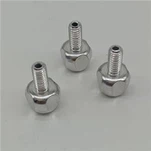
High Accuracy: Precision machining can produce parts with tolerances as tight as a few microns, ensuring that each part meets exacting specifications.
Consistency: The use of computer-controlled machinery means that each part produced will be identical to the next, providing a high level of consistency that is difficult to achieve with manual machining.
Complex Shapes: Complex and intricate geometries that are impossible or very difficult to produce through manual machining can be easily created with precision machining.
Material Efficiency: Because of the high level of accuracy, less material is wasted during the machining process. This can lead to significant cost savings, especially when working with expensive materials.
Reduced Lead Times: The automation inherent in precision machining can significantly reduce the time it takes to go from design to finished part, speeding up the production process.
Improved Surface Finish: Precision machines can achieve superior surface finishes, reducing or eliminating the need for secondary finishing operations.
Repeatability: The process is highly repeatable, ensuring that subsequent production runs will produce parts of the same high quality as the initial run.
Reduced Labor Costs: While precision machinery can be expensive, the reduction in skilled labor required for operation can lead to lower overall labor costs.
Flexibility: Precision machining centers can often switch between different part designs with minimal downtime, providing greater flexibility in production.
Customization: The process is well-suited to producing small batches of custom parts, making it ideal for prototyping and low-volume production runs.
Reliability: Precision machines are designed to operate reliably for extended periods, reducing the risk of production delays due to machine failure.
Technical Capabilities: Modern precision machining centers are often equipped with advanced features such as multi-axis capabilities, which allow for the production of parts with complex three-dimensional shapes.
Quality Control: Many precision machines are equipped with built-in sensors and monitoring systems that can detect and correct deviations from the desired specifications, ensuring a high-quality product.
Environmental Control: The controlled environment in which precision machining takes place can be critical for producing parts with specific environmental requirements, such as those sensitive to temperature or humidity variations.
Integration with CAD/CAM: Precision machining can be seamlessly integrated with computer-aided design (CAD) and computer-aided manufacturing (CAM) software, streamlining the design-to-production process.
The advantages of precision machining make it an indispensable process in modern manufacturing, where the demand for high-quality, complex, and accurate parts is ever-increasing.