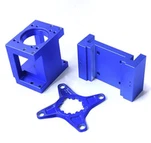
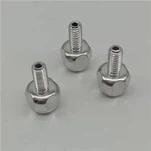
In the field of mechanical engineering, various processes are employed for the processing of mechanical parts. Here's an introduction to several common processes used in part machining:
Turning: This is a fundamental process where a cutting tool, typically a single-point tool, is used to remove material from the surface of a rotating workpiece. It is commonly used for external cylindrical shapes and can also be used for facing, boring, and cutting threads.
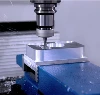
Milling: Milling involves the use of a rotating multi-toothed cutter that removes material by feeding into the workpiece. It is versatile and can be used for a wide range of operations, including flat surfaces, slots, pockets, and complex three-dimensional contours.
Drilling: Drilling is the process of creating holes in a workpiece using a rotating cutting tool. It is essential for creating the necessary holes for assembly and other functional requirements in parts.
Grinding: Grinding is an abrasive process that uses a grinding wheel to achieve high levels of surface finish and accuracy. It is often used for finishing operations after other machining processes to refine the surface and achieve tight tolerances.
Boring: Boring is a internal turning process used to enlarge or finish the interior of a hole. It is often used to achieve a high degree of accuracy in the diameter and shape of the hole.
Cutting: Cutting processes such as sawing, shearing, and plasma cutting are used to separate parts from stock material. These processes are essential for initial shaping and are often followed by more precise machining operations.
Threading: Threading is the process of creating helical ridges or threads on the external or internal surface of a part. It is crucial for parts that require fastening or engagement with other threaded components.
Broaching: Broaching is a process that uses a series of cutting teeth to remove material and create a specific shape or size. It is known for its high production rates and precision in producing complex shapes.
Lathe Work: Work done on a lathe involves various operations such as turning, boring, and threading. Lathes are used to produce symmetrical parts that are rotated around an axis of rotation.
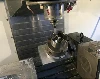
Machining Centers: Machining centers are computer-controlled machines that can perform multiple types of machining operations, such as milling, drilling, and tapping, in a single setup. They are highly automated and can produce complex parts with high precision.
Each of these processes has its own set of advantages and is chosen based on the specific requirements of the part being manufactured, including material type, desired shape, tolerances, and production volume. The selection of the right process is crucial for achieving the desired quality and efficiency in part production.