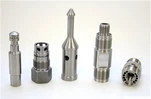
Main Challenges in Stainless Steel Parts Machining
Stainless steel is widely used across industries due to its excellent corrosion resistance, strength, and aesthetic appeal. However, it also presents several significant machining difficulties that manufacturers must address:
1. High Work Hardening Tendency
Stainless steel, especially austenitic grades like 304 and 316, exhibits severe work hardening during cutting. As the tool engages the material, the surface layer hardens rapidly, causing cutting forces to increase and accelerating tool wear. This often requires multiple roughing passes before finishing to avoid damaging tools or the workpiece.
2. Poor Thermal Conductivity
Compared to carbon steel or aluminum, stainless steel has relatively low thermal conductivity. Most of the cutting heat concentrates at the tool–chip interface rather than dissipating through the workpiece or chip. This elevated temperature accelerates tool degradation, reduces tool life, and can cause thermal deformation of the workpiece.
3. Strong Chip Adhesion and Built-Up Edge (BUE)
Stainless steel tends to produce long, continuous chips that adhere strongly to the tool rake face. This built-up edge phenomenon alters the effective tool geometry, degrades surface finish, and can lead to unpredictable dimensional accuracy. Specialized chip breakers and optimized cutting parameters are essential to control chip formation.
4. High Cutting Forces and Power Consumption
The material's toughness and strength result in higher cutting forces during machining. This demands more rigid machine tools, robust fixturing, and greater spindle power. Insufficient machine rigidity can lead to chatter, vibration marks, and poor surface quality.
5. Tool Wear and Cost
The combination of high temperatures, abrasive carbide particles in the material, and chemical reactivity causes rapid tool wear-particularly crater wear on the rake face and flank wear. Carbide or coated tools (TiAlN, TiCN) are typically required, and cutting speeds must often be reduced compared to other materials, increasing cycle time and tooling costs.
6. Surface Finish and Dimensional Accuracy
Achieving fine surface finishes is challenging due to the material's tendency to smear and gall. Additionally, residual stresses from machining can cause warping or distortion, especially in thin-walled or complex geometries, making tight tolerances difficult to maintain.
7. Material Variability
Different stainless steel grades (austenitic, martensitic, ferritic, duplex, precipitation-hardening) behave very differently during machining. For example, free-machining grades like 303 contain sulfur additions to improve machinability, while super duplex grades are extremely difficult to cut. Selecting appropriate parameters and tools for each grade is critical.
Summary Table
表格
| Challenge | Primary Cause | Typical Mitigation |
|---|---|---|
| Work hardening | Austenitic microstructure | Sharp tools, positive rake angles, adequate depth of cut |
| Heat concentration | Low thermal conductivity | High-pressure coolant, reduced cutting speeds |
| Chip adhesion | High ductility, low thermal conductivity | Chip breakers, optimized feed rates |
| High cutting forces | High toughness and strength | Rigid setups, lower feeds, climb milling |
| Rapid tool wear | Abrasion + high temperatures | Coated carbide/ceramic tools, proper coolant |
| Surface finish issues | Galling and smearing | Polished tool flanks, stable cutting conditions |