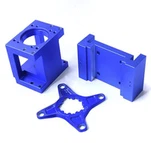
Batch Aluminum Alloy CNC Machining
Overview
Batch aluminum alloy CNC machining refers to the production of multiple identical or similar aluminum components using computer numerical control equipment in manufacturing runs ranging from small lots to high-volume serial production. Aluminum alloys are particularly well-suited for batch CNC machining due to their excellent machinability, favorable cost structure, lightweight properties, and wide availability. Successful batch production requires careful consideration of process consistency, tooling strategies, workholding efficiency, quality control methodologies, and economic optimization to achieve competitive unit costs while maintaining stringent quality standards across every component.
Material Selection for Batch Production
The choice of aluminum alloy significantly impacts batch machining economics and consistency. 6061-T6 dominates batch production applications due to its outstanding balance of machinability, mechanical properties, availability, and cost. This alloy machines predictably with standard carbide tooling, produces manageable chips, and achieves excellent surface finishes, making it ideal for robotic components, automotive brackets, electronic enclosures, and general industrial hardware produced in quantities from dozens to thousands of units.
6063-T6 offers slightly lower strength but superior extrudability and surface finish quality, often selected for batch-produced architectural profiles, decorative components, and heat sink applications where anodized appearance is important.
7075-T6 serves batch applications requiring higher strength-to-weight ratios, such as aerospace fittings, high-performance sporting equipment, and precision mechanical components. The increased tool wear and more demanding machining parameters associated with this alloy are justified by performance requirements, though batch economics must account for accelerated tooling consumption.
5083-H111 and 5754-H22 are chosen for batch marine and chemical industry components where corrosion resistance outweighs absolute strength requirements. These alloys machine softly and require sharp tooling to prevent gumming and built-up edge formation.
For high-volume batch production, material consistency from lot to lot is critical. Establishing relationships with mills that provide certified material with tight compositional and mechanical property tolerances reduces process variation and machining parameter adjustment requirements between material deliveries.
Process Planning and Standardization
Successful batch machining begins with comprehensive process planning that standardizes every aspect of production. Detailed process sheets document cutting parameters, tool specifications, tool change intervals, coolant concentrations, and quality checkpoints. Standardization ensures that the fiftieth component receives identical treatment to the first, maintaining dimensional consistency throughout the batch.
Process capability studies conducted during initial setup establish statistical confidence in the machining process. By measuring sample components and calculating capability indices (Cp and Cpk), manufacturers verify that natural process variation remains well within specification limits. A minimum Cpk of 1.33 is typically targeted for batch production, indicating that the process can consistently produce conforming parts.
First article inspection validates the complete process before batch commencement. Every feature on the initial component is measured and compared against design specifications. Only after first article approval does serial production proceed, preventing costly discovery of systematic errors mid-batch.
Workholding and Fixture Strategies
Efficient batch production depends heavily on workholding solutions that balance repeatability, setup speed, and clamping reliability.
Dedicated fixtures designed for specific components provide the highest repeatability and fastest loading times. Pneumatic or hydraulic clamping systems enable rapid part changeover, reducing non-cutting time between components. For batch quantities exceeding several hundred units, dedicated fixture investment is readily justified by productivity gains.
Modular fixture systems with interchangeable locators and clamps offer flexibility for medium batch sizes where dedicated tooling would be uneconomical. These systems allow rapid reconfiguration between different part numbers while maintaining adequate positioning accuracy for most aluminum machining applications.
Vacuum workholding is particularly effective for batch production of thin-walled aluminum components such as electronic enclosures, heat sinks, and cover plates. Vacuum fixtures distribute clamping forces evenly, preventing distortion of compliant sections, and enable very fast part loading and unloading.
** tombstone fixtures** with multiple faces allow simultaneous machining of several components or multiple operations, maximizing spindle utilization and reducing per-part cycle time in batch environments.
Tooling Management and Optimization
Consistent tool life and cutting performance are essential for batch production stability. Predictable tool wear patterns enable scheduled tool changes before quality degradation occurs, avoiding unexpected downtime or scrap production.
Tool presetting outside the machine ensures that replacement tools match the dimensional and runout characteristics of original tools. Preset tools are loaded directly into the machine without manual touch-off, minimizing setup interruption during batch runs.
Tool life monitoring systems track cutting forces, spindle power consumption, or acoustic emissions to detect tool wear progression in real time. When wear indicators exceed predetermined thresholds, automatic tool changes or operator alerts prevent continued machining with degraded cutters.
High-performance tooling including polished flute carbide end mills, through-coolant drills, and coated inserts extends batch run times between tool changes. For aluminum batch production, uncoated or diamond-coated tools often outperform titanium nitride coatings, as aluminum's gummy chip formation benefits from polished surfaces that prevent material adhesion.
Machining Parameter Strategies
Batch production parameters balance material removal rate, surface quality, and tool life to minimize cost per component.
High-speed machining strategies with elevated spindle speeds and moderate depths of cut are particularly effective for aluminum batch production. These parameters reduce cutting forces, minimize thermal effects, and enable excellent surface finishes. Typical values for 6061-T6 might include spindle speeds of 10,000 to 20,000 RPM for end milling operations, with feed rates optimized for chip load per tooth.
Adaptive machining adjusts feed rates in real time based on actual cutting forces, maintaining consistent tool loading through varying engagement conditions. This prevents overload in corner entries and full-width cuts while maximizing productivity in lighter engagement zones.
Trochoidal milling and high-efficiency milling tool paths maintain constant tool engagement angles, enabling aggressive material removal rates without overloading the cutter. These strategies are especially valuable for batch production of aluminum components with deep pockets and extensive material removal requirements.
Quality Control in Batch Production
Maintaining quality consistency across hundreds or thousands of components requires systematic inspection approaches.
In-process inspection using machine-integrated touch probes verifies critical dimensions between operations. Probing routines automatically compensate for tool wear offsets or thermal drift, maintaining process centering without manual intervention.
Statistical process control (SPC) monitors measured features across sequential components, plotting data on control charts that reveal trends, shifts, or increasing variation. Early detection of process drift enables corrective action before out-of-specification parts are produced.
Sampling inspection plans define measurement frequencies based on batch size and quality history. For stable processes with demonstrated capability, reduced sampling frequencies maintain quality assurance while minimizing inspection costs. New or less stable processes require more frequent measurement until sufficient data establishes process reliability.
Automated inspection systems including optical comparators, laser scanners, and robotic CMM loading further reduce inspection cycle times in high-volume batch environments.
Coolant and Chip Management
Aluminum batch production generates substantial chip volumes that must be efficiently managed. High-pressure coolant systems with through-tool delivery improve chip evacuation from deep pockets and holes, preventing recutting that degrades surface finish and accelerates tool wear.
Concentration-controlled coolant systems maintain consistent cutting fluid properties throughout extended batch runs. Automated refractometers and topping systems prevent coolant degradation that would otherwise affect machining performance and part cleanliness.
Centralized chip conveying and processing systems remove chips from machine enclosures continuously, preventing accumulation that would interfere with machining operations or pose fire risks with fine aluminum particles.
Production Scheduling and Workflow Optimization
Batch production economics depend heavily on workflow efficiency. Group technology organizes components by geometric similarity, enabling shared fixturing, tooling, and machining strategies that reduce changeover times between batches.
Just-in-time production scheduling minimizes work-in-process inventory while ensuring component availability for downstream assembly. For aluminum batch components feeding robotic arm assembly, synchronized production schedules prevent either component shortages or excessive inventory carrying costs.
Lights-out manufacturing extends batch production beyond standard operating hours through automated machine loading, tool life monitoring, and remote process supervision. Aluminum's forgiving machining characteristics make it particularly suitable for unmanned operation, provided chip management and coolant systems are adequately designed for extended unattended running.
Cost Optimization Considerations
Per-unit cost in batch production follows a characteristic curve where initial setup and tooling costs are amortized across increasing quantities. Economic order quantity analysis determines optimal batch sizes balancing setup costs, inventory carrying costs, and production efficiency.
Value engineering reviews component designs for manufacturability improvements that reduce machining time without compromising function. Simple modifications such as standardizing hole sizes, increasing internal corner radii to match standard cutter diameters, or eliminating unnecessary surface finish specifications can significantly impact batch economics.
Material utilization optimization through nesting of multiple components from single workpieces, or selection of near-net-shape extrusions and castings, reduces raw material waste and machining time.
Conclusion
Batch aluminum alloy CNC machining represents a mature, efficient manufacturing methodology serving diverse industries from robotics and aerospace to automotive and consumer electronics. Success in batch production depends on systematic process standardization, intelligent workholding design, proactive tooling management, statistical quality control, and continuous workflow optimization. The favorable machining characteristics of aluminum alloys, particularly the 6xxx series, enable high productivity and consistent quality when supported by appropriate equipment, processes, and management practices. As manufacturing volumes grow and automation technologies advance, batch aluminum CNC machining continues to evolve toward ever-greater efficiency, precision, and economic competitiveness.