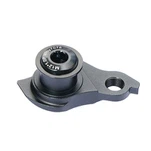
Below is a concise English overview of the main application fields that rely on precision machining. Every sector listed demands micron-level tolerances, ultra-fine surface finishes, or complex geometries that can only be achieved by precision CNC turning, 5-axis milling, Swiss-type machining, EDM, grinding, laser micro-processing, etc.
Aerospace & Defense
Turbine blades, blisks, impellers, fuel nozzles, hydraulic manifolds, landing-gear parts
Materials: Ti-6Al-4V, Inconel, Waspaloy, 7075-T6, composites
Tolerances down to ±5 µm and Ra 0.2 µm; mandatory Nadcap & AS9100 compliance
Medical & Dental Devices
Orthopedic implants (hips, knees, spinal cages), bone screws, surgical instruments, dental crowns, stents
Biocompatible alloys: Ti-ELI, 316LVM, Co-Cr-Mo, PEEK
Requires burr-free edges, Ra 0.1 µm finishes, and lot-level traceability for FDA approval
Automotive / Motorsport
Fuel-injection components, transmission valves, turbocharger wheels, e-motor shafts, ABS housings
High-volume CNC cells with Cpk ≥ 1.67; super-finishing for friction reduction and NVH control
Optics, Photonics & Lasers
Aluminum 6061 mirrors, copper mirrors for CO₂ lasers, lens holders, fiber-optic ferrules, micro-prisms
Achieves form errors < 0.2 µm and surface roughness < 5 nm (diamond turning) for minimal scatter
Electronics, Semiconductors & Telecommunications
Heat sinks, RF waveguides, connector pins, lead frames, micro-fluidic chips, ATE test sockets
Micro-machining 0.05-mm drills; tight position accuracy (±2 µm) for 5G signal integrity
Energy & Power Generation
Gas-turbine vanes, nuclear reactor stems, fuel-cell plates, battery housings, down-hole drilling tools
Must resist high pressure, corrosion, and temperature cycling; Inconel 718 & super-duplex SS common
Precision Instruments & Metrology
CMM stylus holders, gauge blocks, calibration artifacts, optical stages, robot joints
Parts often serve as reference standards themselves-tolerances below ±1 µm and surface flatness < 0.3 µm
Micromechanics & Watchmaking
Gear trains, escapement wheels, balance shafts, micro screws (M0.6), jewel settings
Brass, free-cutting steel, hardenable stainless; Ra 0.05 µm for low friction and noise
Mold, Die & Tool Making
Injection molds for smartphone cases, lens arrays, micro-fluidic chips; stamping dies for connectors
Hardened tool steel (H13, S136) machined to ±3 µm, then polished to mirror Ra 0.01 µm
Space & Satellite Hardware
Reaction-wheel housings, optical bench structures, propulsion micro-valves, CubeSat frames
Demands lightweighting, minimal distortion across –150 °C to +120 °C, and outgassing-compliant finishes
Across all of these fields, precision machining is the enabling technology that turns advanced design concepts into reliable, high-performance hardware.