What is the Poisson's ratio of custom titanium parts?
As a seasoned supplier of custom titanium parts, I've had numerous clients inquire about the Poisson's ratio of these components. This fundamental material property plays a crucial role in the design and performance of titanium parts, and understanding it is essential for making informed decisions in various industries, from aerospace to medical devices.
Understanding Poisson's Ratio
Poisson's ratio, denoted by the Greek letter ν (nu), is a measure of the transverse contraction strain to the longitudinal extension strain in a material when it is subjected to uniaxial stress. In simpler terms, when you pull on a material in one direction, it will not only stretch in that direction but also contract in the perpendicular directions. Poisson's ratio quantifies this relationship.


Mathematically, Poisson's ratio is defined as the negative ratio of the transverse strain (ε_transverse) to the longitudinal strain (ε_longitudinal):
ν = -ε_transverse / ε_longitudinal
The value of Poisson's ratio typically ranges from -1 to 0.5 for most materials. A value of 0.5 indicates that the material is incompressible, meaning that its volume remains constant when deformed. On the other hand, a negative Poisson's ratio implies that the material expands transversely when stretched longitudinally, which is a rare but fascinating property found in some engineered materials.
Poisson's Ratio of Titanium
Titanium and its alloys are known for their excellent mechanical properties, including high strength-to-weight ratio, corrosion resistance, and biocompatibility. The Poisson's ratio of titanium typically falls within the range of 0.32 to 0.34, depending on the specific alloy and its microstructure.
This value is relatively consistent across different titanium alloys, such as Ti-6Al-4V, which is one of the most widely used titanium alloys in various industries. The relatively high Poisson's ratio of titanium indicates that it experiences significant transverse contraction when subjected to longitudinal stress. This property has important implications for the design and performance of custom titanium parts.
Importance of Poisson's Ratio in Custom Titanium Parts
The Poisson's ratio of titanium plays a crucial role in several aspects of custom titanium part design and performance:
- Stress Analysis: When designing custom titanium parts, engineers need to perform stress analysis to ensure that the parts can withstand the expected loads without failure. Poisson's ratio is an essential input parameter in these analyses, as it affects the distribution of stresses and strains within the material. By accurately accounting for Poisson's ratio, engineers can optimize the design of the parts to minimize stress concentrations and improve their overall performance.
- Dimensional Stability: The transverse contraction associated with Poisson's ratio can have a significant impact on the dimensional stability of custom titanium parts. For example, in precision machining applications, even small changes in dimensions can affect the fit and function of the parts. By understanding the Poisson's ratio of titanium, manufacturers can compensate for the transverse contraction during the machining process and ensure that the final parts meet the required dimensional tolerances.
- Fatigue Life: Fatigue failure is a common mode of failure in custom titanium parts, especially in applications where the parts are subjected to cyclic loading. Poisson's ratio can influence the fatigue life of titanium parts by affecting the crack initiation and propagation processes. By selecting the appropriate titanium alloy and optimizing the design of the parts based on their Poisson's ratio, manufacturers can improve the fatigue resistance of the parts and extend their service life.
- Material Selection: The Poisson's ratio of titanium can also influence the selection of materials for specific applications. For example, in applications where dimensional stability is critical, such as in aerospace components, a titanium alloy with a lower Poisson's ratio may be preferred. On the other hand, in applications where high strength and ductility are required, a titanium alloy with a higher Poisson's ratio may be more suitable.
Custom Titanium Parts and Poisson's Ratio
As a supplier of custom titanium parts, we understand the importance of Poisson's ratio in the design and performance of these components. We work closely with our clients to ensure that they have a clear understanding of the Poisson's ratio of the titanium alloys we use and how it can affect the performance of their parts.
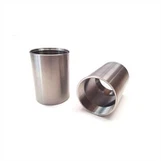
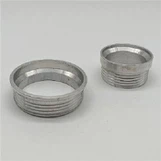
We offer a wide range of custom titanium parts, including Titanium CNC Turning Parts and Titanium CNC Milling Parts, which are manufactured using state-of-the-art CNC machining technology. Our experienced engineers and technicians have extensive knowledge of the properties of titanium and its alloys, and they can help you select the appropriate material and design the parts to meet your specific requirements.
In addition to our machining capabilities, we also offer a range of value-added services, such as heat treatment, surface finishing, and quality inspection. These services ensure that our custom titanium parts meet the highest standards of quality and performance.
Conclusion
In conclusion, the Poisson's ratio of titanium is an important material property that plays a crucial role in the design and performance of custom titanium parts. By understanding the Poisson's ratio of titanium and its implications, engineers and manufacturers can optimize the design of the parts, improve their dimensional stability, enhance their fatigue resistance, and select the appropriate materials for specific applications.
As a supplier of custom titanium parts, we are committed to providing our clients with high-quality products and services that meet their specific requirements. If you have any questions or need further information about the Poisson's ratio of custom titanium parts or our products and services, please do not hesitate to contact us. We look forward to working with you to develop innovative solutions for your custom titanium part needs.
References
- Callister, W. D., & Rethwisch, D. G. (2017). Materials Science and Engineering: An Introduction. Wiley.
- ASM Handbook, Volume 2: Properties and Selection: Nonferrous Alloys and Special-Purpose Materials. ASM International.