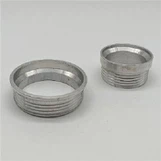
Hey there! As a supplier of Titanium Fasteners, I often get asked about the elongation percentage of these nifty little components. So, I thought I'd take some time to break it down for you all.
First off, let's talk about what elongation percentage actually means. In simple terms, it's a measure of how much a material can stretch before it breaks. When we're dealing with titanium fasteners, this is a super important factor. You see, fasteners are used in all sorts of applications, from bicycles to aerospace equipment. And in these applications, they need to be able to withstand a certain amount of stress without failing.
Titanium is a great material for fasteners for a whole bunch of reasons. It's lightweight, strong, and resistant to corrosion. But the elongation percentage is what really makes it stand out. Unlike some other metals, titanium has a relatively high elongation percentage, which means it can stretch quite a bit before it snaps.
So, what's the typical elongation percentage for titanium fasteners? Well, it can vary depending on a few factors, like the specific grade of titanium used and the manufacturing process. Generally speaking, though, you can expect an elongation percentage of around 10% to 30%. That might not sound like a lot, but when you think about it, it's actually pretty impressive. It means that the fastener can stretch to 10% to 30% of its original length before it breaks.
Let's take a closer look at why this is so important. In a bicycle, for example, the fasteners are used to hold the frame together. When you're riding, the frame is constantly being subjected to stress and vibrations. If the fasteners don't have a high enough elongation percentage, they could break under this stress, which could lead to a serious accident. But with titanium fasteners, you can be confident that they'll be able to withstand the stress and keep your bike safe.
Another advantage of the high elongation percentage of titanium fasteners is that it allows for some flexibility in the design. Engineers can design parts that are more complex and have tighter tolerances, knowing that the fasteners will be able to handle the stress. This can lead to more efficient and reliable products.
Now, I know what you're thinking. "That all sounds great, but how do I know if the titanium fasteners I'm buying are up to par?" Well, that's where we come in. As a supplier of Titanium Fasteners, we take quality very seriously. We only use the highest grade of titanium and follow strict manufacturing processes to ensure that our fasteners meet the highest standards.
We also offer a wide range of titanium fasteners to suit different applications. Whether you're building a bicycle, an airplane, or a piece of industrial equipment, we've got the right fasteners for you. And if you're not sure which fasteners are right for your project, our team of experts is always here to help.


In addition to our titanium fasteners, we also offer Other Titanium Bicycle Frame Parts. These parts are made from the same high-quality titanium and are designed to work seamlessly with our fasteners. So, if you're looking to build a high-performance bicycle, we've got everything you need.
So, there you have it. That's a quick overview of the elongation percentage of titanium fasteners. I hope this has been helpful. If you have any more questions or if you're interested in purchasing our titanium fasteners or other titanium parts, please don't hesitate to get in touch. We'd love to hear from you and help you with your project.
References:
- Material Science textbooks on titanium properties
- Industry standards for titanium fasteners