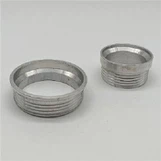
When it comes to custom titanium parts, the finishing options play a crucial role in determining the final functionality, appearance, and durability of the components. As a leading supplier of custom titanium parts, we understand the importance of offering a wide range of finishing options to meet the diverse needs of our customers. In this blog post, we will explore the various finishing options available for custom titanium parts and how they can enhance the performance and aesthetics of your products.
Machining Finishes
CNC Milling and Turning
CNC machining is a popular method for creating custom titanium parts with high precision and accuracy. Our Titanium CNC Milling Parts and Titanium CNC Turning Parts are produced using state - of - the - art CNC machines. After the initial machining process, the parts can be left with a machined finish. This finish has a smooth surface with visible tool marks that are characteristic of the machining process. It is suitable for applications where a functional, cost - effective finish is required, such as in mechanical components that do not need a highly polished appearance.
The surface roughness of a machined finish can be controlled to some extent by adjusting the cutting parameters, such as the feed rate, spindle speed, and depth of cut. A finer finish can be achieved by using lower feed rates and higher spindle speeds, which result in smaller tool marks and a smoother surface.
Polishing
Polishing is a finishing process that involves using abrasive materials to remove surface irregularities and create a smooth, shiny surface. There are different levels of polishing that can be applied to custom titanium parts:
Mechanical Polishing
Mechanical polishing is the most common method. It starts with coarse abrasives to remove any large surface defects and then progresses to finer abrasives to achieve a mirror - like finish. This process can significantly improve the appearance of the titanium parts, making them more aesthetically pleasing. It is often used in applications where visual appeal is important, such as in jewelry, high - end consumer products, and architectural components.
Electro - Polishing
Electro - polishing is an electrochemical process that uses an electric current to dissolve the surface layer of the titanium part. This results in a smooth, uniform surface with enhanced corrosion resistance. Electro - polished titanium parts have a bright, reflective finish and are free from micro - burrs and sharp edges. It is particularly useful for applications in the medical and food industries, where a clean, non - porous surface is required to prevent the growth of bacteria and ensure product safety.
Anodizing
Anodizing is an electrochemical process that forms a protective oxide layer on the surface of the titanium part. This process not only enhances the corrosion resistance of the titanium but also allows for coloration.
Color Anodizing
Titanium can be anodized to produce a variety of colors, including gold, blue, purple, and black. The color is determined by the thickness of the oxide layer, which can be controlled by adjusting the anodizing voltage. Color anodizing is popular in the jewelry, fashion, and aerospace industries, where it is used to add aesthetic value to the parts and provide some level of protection against wear and corrosion.
Hard Anodizing
Hard anodizing creates a thicker, harder oxide layer on the titanium surface. This layer provides excellent wear resistance, making it suitable for applications where the parts are subject to high levels of friction and abrasion, such as in automotive and industrial machinery components.
Passivation
Passivation is a chemical process that removes free iron and other contaminants from the surface of the titanium part and forms a thin, protective oxide layer. This layer improves the corrosion resistance of the titanium, especially in environments where it may be exposed to moisture, chemicals, or salt.
Passivation is a critical finishing step for titanium parts used in marine applications, chemical processing plants, and outdoor structures. It helps to prevent the formation of rust and other corrosion products, which can compromise the integrity of the parts over time.
Coating
There are several types of coatings that can be applied to custom titanium parts to enhance their performance:
PVD Coating (Physical Vapor Deposition)
PVD coating involves depositing a thin film of a hard material, such as titanium nitride (TiN), titanium carbonitride (TiCN), or chromium nitride (CrN), onto the surface of the titanium part. These coatings provide excellent wear resistance, low friction coefficients, and improved hardness. PVD - coated titanium parts are commonly used in cutting tools, molds, and high - performance mechanical components.
Ceramic Coating
Ceramic coatings offer high - temperature resistance, corrosion resistance, and excellent wear protection. They can be applied to titanium parts using various methods, such as thermal spraying or chemical vapor deposition. Ceramic - coated titanium parts are suitable for applications in the aerospace, automotive, and energy industries, where the parts are exposed to extreme temperatures and harsh environments.
Shot Peening
Shot peening is a cold - working process in which small spherical shots are bombarded onto the surface of the titanium part. This process creates compressive stresses on the surface, which improve the fatigue resistance of the part. Shot - peened titanium parts are less likely to develop cracks and failures under cyclic loading conditions.


Shot peening is commonly used in aerospace components, such as turbine blades and landing gear, where the parts are subjected to repeated stress and vibration.
Selection of Finishing Options
The choice of finishing option for custom titanium parts depends on several factors:
Functionality
If the part is intended for a high - wear application, such as a bearing or a gear, a hard - anodized or PVD - coated finish may be the best choice. For parts that need to resist corrosion in a harsh environment, passivation or electro - polishing may be more suitable.
Appearance
If visual appeal is a priority, polishing or color anodizing can provide the desired aesthetic effect. For example, in the consumer electronics industry, a polished or anodized finish can enhance the brand image and product attractiveness.
Cost
Some finishing processes, such as electro - polishing and PVD coating, can be more expensive than others, such as machining or passivation. Cost is an important consideration, especially for large - scale production. A balance needs to be struck between the desired finish quality and the production cost.
Conclusion
As a custom titanium parts supplier, we offer a comprehensive range of finishing options to meet the diverse requirements of our customers. Whether you need a functional machined finish, a polished and shiny surface, or a protective coating, we have the expertise and capabilities to deliver high - quality custom titanium parts.
If you are in need of custom titanium parts and want to discuss the best finishing options for your specific application, we encourage you to contact us. Our team of experts is ready to work with you to understand your needs and provide you with the most suitable solutions. Let's collaborate to create the perfect custom titanium parts for your project.
References
1.ASM Handbook Volume 5: Surface Engineering. ASM International.
2.Titanium: A Technical Guide, Second Edition. John R. Davis.
3.Materials Science and Engineering: An Introduction, Eighth Edition. William D. Callister, Jr. and David G. Rethwisch.