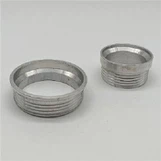
Titanium is a remarkable metal known for its high strength-to-weight ratio, excellent corrosion resistance, and biocompatibility. These properties make it an ideal material for fasteners in various industries, including aerospace, automotive, marine, and bicycle manufacturing. As a Titanium Fasteners supplier, we understand the importance of providing high-quality products that meet the diverse needs of our customers. In this blog post, we will explore the different grades of titanium used in fasteners and their unique characteristics.
Grade 1 Titanium Fasteners
Grade 1 titanium is the purest form of commercially available titanium. It is known for its excellent corrosion resistance, high ductility, and low strength. These properties make it suitable for applications where corrosion resistance is the primary concern, such as marine environments, chemical processing, and medical devices. Grade 1 titanium fasteners are also used in applications where weight is a critical factor, such as aerospace and automotive industries.
One of the key advantages of Grade 1 titanium fasteners is their ability to resist corrosion in a wide range of environments, including seawater, acids, and alkalis. This makes them ideal for use in marine applications, where they are exposed to saltwater and other corrosive substances. Grade 1 titanium fasteners are also biocompatible, which means they can be used in medical devices without causing any adverse reactions in the body.
However, Grade 1 titanium fasteners have relatively low strength compared to other grades of titanium. This limits their use in applications where high strength is required, such as structural components in aerospace and automotive industries. In these applications, higher grades of titanium, such as Grade 5 or Grade 23, are typically used.
Grade 2 Titanium Fasteners
Grade 2 titanium is the most commonly used grade of titanium for fasteners. It is similar to Grade 1 titanium in terms of corrosion resistance and ductility, but it has slightly higher strength. This makes it suitable for a wider range of applications, including those where moderate strength is required.
Grade 2 titanium fasteners are commonly used in the aerospace, automotive, and marine industries. In the aerospace industry, they are used in applications such as aircraft frames, engines, and landing gear. In the automotive industry, they are used in applications such as engine components, suspension systems, and exhaust systems. In the marine industry, they are used in applications such as boat hulls, decks, and rigging.
One of the key advantages of Grade 2 titanium fasteners is their excellent combination of strength and corrosion resistance. They are able to withstand high stresses and loads while maintaining their integrity in corrosive environments. This makes them a reliable choice for applications where both strength and corrosion resistance are important.
Grade 5 Titanium Fasteners
Grade 5 titanium, also known as Ti-6Al-4V, is the most widely used alloy of titanium. It is a high-strength alloy that contains 6% aluminum and 4% vanadium. These alloying elements provide Grade 5 titanium with excellent strength, toughness, and corrosion resistance.
Grade 5 titanium fasteners are commonly used in the aerospace, automotive, and medical industries. In the aerospace industry, they are used in applications such as aircraft frames, engines, and landing gear. In the automotive industry, they are used in applications such as engine components, suspension systems, and exhaust systems. In the medical industry, they are used in applications such as orthopedic implants, dental implants, and surgical instruments.
One of the key advantages of Grade 5 titanium fasteners is their high strength-to-weight ratio. They are able to provide the same level of strength as steel fasteners, but they are significantly lighter. This makes them ideal for applications where weight is a critical factor, such as aerospace and automotive industries.
Grade 23 Titanium Fasteners
Grade 23 titanium, also known as Ti-6Al-4V ELI, is a high-strength alloy that is similar to Grade 5 titanium. However, it has a lower interstitial content, which makes it more biocompatible. This makes it suitable for use in medical applications, such as orthopedic implants, dental implants, and surgical instruments.
Grade 23 titanium fasteners are commonly used in the medical industry because of their excellent biocompatibility and high strength. They are able to withstand the stresses and loads associated with the human body without causing any adverse reactions. This makes them a reliable choice for applications where the safety and well-being of the patient are of utmost importance.
One of the key advantages of Grade 23 titanium fasteners is their ability to integrate with the surrounding bone tissue. This is known as osseointegration, and it is essential for the long-term success of orthopedic implants. Grade 23 titanium fasteners are able to promote osseointegration by providing a stable and supportive environment for the bone tissue to grow.
Other Grades of Titanium Fasteners
In addition to the grades of titanium discussed above, there are several other grades of titanium that are used in fasteners. These grades include Grade 7, Grade 9, Grade 12, and Grade 16. Each of these grades has its own unique characteristics and is suitable for specific applications.
Grade 7 titanium is a low-cost alternative to Grade 2 titanium. It has similar corrosion resistance and ductility, but it has slightly lower strength. This makes it suitable for applications where cost is a major factor, such as consumer products and general industrial applications.
Grade 9 titanium, also known as Ti-3Al-2.5V, is a high-strength alloy that is similar to Grade 5 titanium. However, it has a lower aluminum content, which makes it more weldable. This makes it suitable for applications where welding is required, such as aircraft frames and engine components.


Grade 12 titanium is a high-strength alloy that contains 0.3% molybdenum and 0.8% nickel. These alloying elements provide Grade 12 titanium with excellent corrosion resistance and high strength. It is commonly used in the chemical processing, oil and gas, and marine industries.
Grade 16 titanium is a low-cost alternative to Grade 5 titanium. It has similar strength and corrosion resistance, but it has a lower vanadium content. This makes it suitable for applications where cost is a major factor, such as consumer products and general industrial applications.
Conclusion
In conclusion, the different grades of titanium used in fasteners offer a wide range of properties and characteristics, making them suitable for a variety of applications. As a Titanium Fasteners supplier, we are committed to providing our customers with high-quality products that meet their specific needs. Whether you are looking for fasteners with excellent corrosion resistance, high strength, or biocompatibility, we have the expertise and experience to help you find the right solution.
If you are interested in learning more about our Titanium Fasteners or Other Titanium Bicycle Frame Parts, please do not hesitate to contact us. Our team of experts will be happy to assist you with your procurement needs and provide you with detailed information about our products and services. We look forward to working with you and helping you achieve your goals.
References
- ASM Handbook Volume 2: Properties and Selection: Nonferrous Alloys and Special-Purpose Materials. ASM International.
- Titanium: A Technical Guide. John R. Davis. ASM International.
- Titanium Alloys: Fundamentals and Applications. Edited by David E. Alexander, David L. Anton, and William C. Oliver. John Wiley & Sons.