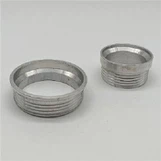
Selecting the appropriate titanium grade for custom parts is a critical decision that can significantly impact the performance, durability, and cost - effectiveness of the final product. As a custom titanium parts supplier, I have witnessed firsthand how the right choice of titanium grade can make or break a project. In this blog, I will share some insights on how to make this important selection based on the application.
Understanding Titanium Grades
Titanium is available in a variety of grades, each with its own unique set of properties. These grades can be broadly classified into commercially pure (CP) titanium and titanium alloys.
Commercially pure titanium is known for its excellent corrosion resistance, high ductility, and biocompatibility. It is available in four grades: Grade 1, Grade 2, Grade 3, and Grade 4. Grade 1 is the most ductile and has the lowest strength, while Grade 4 has the highest strength among the CP titanium grades.
Titanium alloys, on the other hand, are created by adding other elements such as aluminum, vanadium, molybdenum, and zirconium to titanium. These additions enhance the strength, heat resistance, and other mechanical properties of titanium. Some of the most common titanium alloys include Ti - 6Al - 4V (Grade 5), Ti - 6Al - 2Sn - 4Zr - 2Mo (Grade 6), and Ti - 3Al - 2.5V (Grade 9).
Factors to Consider When Selecting Titanium Grades Based on Application
1. Corrosion Resistance
If the custom part will be exposed to corrosive environments such as saltwater, chemicals, or acidic solutions, corrosion resistance is a primary concern. Commercially pure titanium grades, especially Grade 1 and Grade 2, are excellent choices due to their high corrosion resistance. For example, in marine applications where parts are constantly in contact with saltwater, Grade 2 titanium is often used for components like boat fittings and underwater fasteners.
In more severe corrosive environments, titanium alloys with enhanced corrosion - resistant properties may be required. For instance, Ti - 32Mo alloy is highly resistant to pitting and crevice corrosion in chloride - containing environments, making it suitable for chemical processing equipment.
2. Strength Requirements
The strength needed for the custom part depends on the load it will bear. For applications that require high strength - to - weight ratio, such as aerospace components, titanium alloys are the preferred choice. Ti - 6Al - 4V (Grade 5) is one of the most widely used titanium alloys in the aerospace industry. It offers excellent strength, good fatigue resistance, and is relatively lightweight. It is commonly used for aircraft frames, landing gear components, and engine parts.
If the part does not need extremely high strength but still requires some degree of durability, commercially pure titanium grades can be considered. For example, in medical implants where strength is important but not as critical as in aerospace applications, Grade 2 titanium is often used due to its combination of moderate strength and biocompatibility.
3. Temperature Resistance
When the custom part will be exposed to high temperatures, temperature resistance becomes a crucial factor. Titanium alloys generally have better high - temperature performance than commercially pure titanium. Ti - 6Al - 4V (Grade 5) can maintain its strength at temperatures up to about 400°C (752°F), making it suitable for applications in jet engines and high - temperature industrial processes.
For even higher temperature applications, alloys like Ti - 6Al - 2Sn - 4Zr - 2Mo (Grade 6) can be used. This alloy can withstand temperatures up to 540°C (1004°F) and is often used in aerospace and high - performance automotive applications.
4. Machinability
The ease of machining the titanium grade is also an important consideration, especially for custom parts that require complex shapes. Commercially pure titanium grades are generally more machinable than titanium alloys. Grade 1 and Grade 2 titanium can be machined using conventional machining methods such as Titanium CNC Milling Parts and Titanium CNC Turning Parts with relative ease.
Titanium alloys, on the other hand, are more difficult to machine due to their high strength and work - hardening characteristics. However, with the right machining techniques and tools, it is still possible to produce high - quality custom parts from titanium alloys.
5. Cost
Cost is always a factor in any manufacturing project. Commercially pure titanium grades are generally less expensive than titanium alloys. If the application does not require the enhanced properties of an alloy, using a commercially pure titanium grade can significantly reduce the cost. However, in applications where the performance benefits of an alloy are essential, the higher cost may be justified.
Case Studies
Case 1: Medical Implants
In the medical industry, the selection of titanium grade for implants is crucial. For dental implants, biocompatibility is of utmost importance. Commercially pure titanium Grade 2 is often used because it is well - tolerated by the human body and has sufficient strength for this application. The implant needs to be able to integrate with the surrounding bone tissue without causing an immune response.
For orthopedic implants such as hip and knee replacements, Ti - 6Al - 4V (Grade 5) is commonly used. These implants need to withstand high loads and have good fatigue resistance over a long period. The high strength and fatigue - resistant properties of Grade 5 titanium make it suitable for these demanding applications.


Case 2: Aerospace Components
In the aerospace industry, the requirements for custom parts are extremely high. For aircraft wings, which need to be lightweight yet strong enough to withstand aerodynamic forces, Ti - 6Al - 4V (Grade 5) is a popular choice. Its high strength - to - weight ratio allows for the design of more efficient and fuel - saving aircraft.
For components in the engine, where high - temperature resistance is required, alloys like Ti - 6Al - 2Sn - 4Zr - 2Mo (Grade 6) are used. These alloys can maintain their mechanical properties at high temperatures, ensuring the reliable operation of the engine.
Conclusion
Selecting the appropriate titanium grade for custom parts based on the application is a complex but essential process. By considering factors such as corrosion resistance, strength requirements, temperature resistance, machinability, and cost, you can make an informed decision that will result in a high - quality, cost - effective product.
As a custom titanium parts supplier, we have the expertise and experience to help you choose the right titanium grade for your specific application. Whether you need Titanium CNC Milling Parts or Titanium CNC Turning Parts, we can provide you with customized solutions that meet your exact requirements. If you are interested in discussing your project and exploring the best titanium grade options, please feel free to contact us for a detailed consultation.
References
- “Titanium: Properties, Processing, and Applications” by ASM International.
- “Corrosion Resistance of Titanium Alloys” by NACE International.
- “Aerospace Materials Handbook: Titanium Alloys” by SAE International.