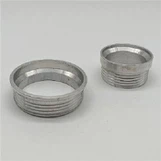
Hey there! As a supplier in the titanium machining industry, I've had my fair share of experiences when it comes to designing fixtures for titanium machining. It's a crucial part of the process, and getting it right can make a huge difference in the quality and efficiency of your work. So, let's dive into how to design fixtures for titanium machining.
Understanding Titanium's Properties
First things first, we need to understand what makes titanium such a unique material. Titanium is known for its high strength-to-weight ratio, excellent corrosion resistance, and biocompatibility. But it also has some properties that can make machining a bit tricky. For example, titanium has a low thermal conductivity, which means that heat generated during machining tends to stay in the cutting zone. This can lead to high temperatures, which can cause tool wear and affect the surface finish of the part.
Another thing to keep in mind is that titanium is a reactive metal. It can react with oxygen and nitrogen at high temperatures, forming hard and brittle compounds on the surface. This can also cause problems during machining, such as tool chipping and poor surface quality.
Considerations for Fixture Design
When designing fixtures for titanium machining, there are several key considerations to keep in mind.
1. Rigidity
Titanium machining often involves high cutting forces, so the fixture needs to be rigid enough to withstand these forces without deflecting. Any deflection can lead to inaccurate machining and poor part quality. To ensure rigidity, you can use thick and sturdy materials for the fixture base and supports. You can also add reinforcement ribs or gussets to increase the stiffness of the fixture.
2. Clamping Force
Proper clamping is essential to hold the titanium workpiece securely in place during machining. However, you need to be careful not to apply too much clamping force, as this can cause the workpiece to deform. On the other hand, if the clamping force is too low, the workpiece may move during machining, resulting in inaccurate cuts. It's important to find the right balance and use clamping mechanisms that can apply a uniform and controlled clamping force.
3. Thermal Management
As mentioned earlier, titanium has low thermal conductivity, which can lead to heat buildup during machining. To prevent this, the fixture should be designed to dissipate heat effectively. You can use materials with good thermal conductivity for the fixture components, such as aluminum or copper. You can also incorporate cooling channels or fins into the fixture design to help remove heat from the cutting zone.
4. Chip Evacuation
During titanium machining, a large amount of chips are generated. If these chips are not removed quickly and efficiently, they can accumulate in the cutting zone, causing tool damage and poor surface finish. The fixture should be designed to allow for easy chip evacuation. You can include chip flutes or grooves in the fixture to direct the chips away from the cutting area. You can also use a coolant system to flush the chips out of the fixture.
5. Accessibility
The fixture should provide easy access to the workpiece for machining operations. This means that the fixture should not interfere with the cutting tool's path or block the operator's view. You may need to design the fixture with removable or adjustable components to allow for better access to different areas of the workpiece.
Types of Fixtures for Titanium Machining
There are several types of fixtures that can be used for titanium machining, depending on the specific requirements of the job.
1. Vise Fixtures
Vise fixtures are one of the most common types of fixtures used in machining. They are simple and easy to use, and they can provide a high degree of clamping force. Vise fixtures are suitable for holding small to medium-sized titanium workpieces. You can choose from different types of vises, such as mechanical vises, hydraulic vises, or pneumatic vises, depending on your needs.
2. Indexing Fixtures
Indexing fixtures are used when you need to machine multiple sides or features of a titanium workpiece. These fixtures allow you to rotate the workpiece to different positions, so you can perform machining operations on different surfaces without having to re-clamp the workpiece. Indexing fixtures can be manual or automatic, and they can be used in combination with other types of fixtures.
3. Custom Fixtures
In some cases, standard fixtures may not be suitable for your titanium machining requirements. In these situations, you may need to design and manufacture custom fixtures. Custom fixtures can be tailored to the specific shape, size, and machining requirements of your workpiece. They can provide a high degree of accuracy and repeatability, but they can also be more expensive and time-consuming to design and manufacture.


Design Process
The design process for titanium machining fixtures typically involves the following steps:
1. Define the Requirements
The first step is to clearly define the requirements of the fixture. This includes the size and shape of the workpiece, the machining operations to be performed, the required accuracy and surface finish, and any other specific requirements. You should also consider the production volume and the available machining equipment.
2. Conceptual Design
Once you have defined the requirements, you can start developing a conceptual design for the fixture. This involves sketching out different ideas and concepts for the fixture layout, clamping mechanisms, and other components. You can use computer-aided design (CAD) software to create 2D or 3D models of the fixture and visualize how it will work.
3. Detailed Design
After you have selected a conceptual design, you can proceed with the detailed design. This involves specifying the dimensions, materials, and manufacturing processes for each component of the fixture. You should also consider the assembly and disassembly requirements of the fixture, as well as any maintenance or adjustment procedures.
4. Prototyping and Testing
Once the detailed design is complete, you can create a prototype of the fixture. The prototype can be used to test the functionality and performance of the fixture. You can perform machining tests on the prototype using a sample workpiece to check for any issues or problems. Based on the test results, you can make any necessary modifications to the fixture design.
5. Production and Implementation
After the prototype has been tested and approved, you can proceed with the production of the final fixture. The fixture can be manufactured using a variety of processes, such as machining, welding, or casting. Once the fixture is ready, it can be installed on the machining equipment and used for production.
Conclusion
Designing fixtures for titanium machining is a complex but rewarding process. By understanding the properties of titanium, considering the key factors in fixture design, and following a systematic design process, you can create fixtures that are rigid, efficient, and capable of producing high-quality titanium parts.
If you're in the market for Titanium CNC Turning Parts or Titanium CNC Milling Parts, we're here to help. We have the expertise and experience to design and manufacture custom fixtures for your specific titanium machining needs. Whether you're a small shop or a large manufacturing company, we can provide you with high-quality fixtures and machining services.
If you're interested in learning more about our titanium machining capabilities or have any questions about fixture design, feel free to reach out to us. We'd be happy to discuss your requirements and provide you with a quote. Let's work together to achieve your machining goals!
References
- "Machining of Titanium Alloys" by E. Ozel and Y. Altan
- "Fixture Design Principles" by J. A. Schey
- "Manufacturing Engineering and Technology" by S. Kalpakjian and S. R. Schmid