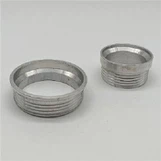
Do titanium fasteners have a good electrical conductivity? Well, that's a question I get asked a lot as a supplier of Titanium Fasteners. Let's dive into this topic and break it down in a way that's easy to understand.
First off, what are titanium fasteners? They're essentially small but crucial components used in a variety of applications, especially in industries where strength, corrosion resistance, and lightweight properties are highly valued. One of the big markets for these fasteners is the bicycle industry. In fact, they're often used alongside Other Titanium Bicycle Frame Parts to build high - performance bikes.
Now, let's talk about electrical conductivity. Electrical conductivity is a measure of how easily an electric current can pass through a material. Metals are generally good conductors of electricity because they have free electrons that can move around easily. For example, copper and aluminum are well - known for their high electrical conductivity and are commonly used in electrical wiring.


When it comes to titanium, things are a bit different. Titanium is not considered a great conductor of electricity compared to metals like copper and silver. Copper has an electrical conductivity of about 5.96×10⁷ S/m (siemens per meter) at room temperature, while silver, which is the best conductor among metals, has a conductivity of around 6.30×10⁷ S/m. In contrast, titanium has an electrical conductivity of approximately 2.38×10⁶ S/m. That's a significant difference!
So, why isn't titanium a great conductor? It all comes down to its atomic structure. Titanium has a relatively high resistance to the flow of electrons. The electrons in titanium are not as free to move as they are in better - conducting metals. The outer electrons in titanium are more tightly bound to the atoms, which restricts their ability to carry an electric current efficiently.
However, just because titanium doesn't have excellent electrical conductivity doesn't mean it's useless in electrical applications. In some cases, its relatively low conductivity can be an advantage. For example, in applications where you want to prevent electrical interference or where you need a material that can act as a partial insulator while still having some electrical properties, titanium can be a good choice.
In the bicycle industry, the low electrical conductivity of titanium fasteners isn't really a concern. Bicycles don't rely on these fasteners for electrical conduction. Instead, the focus is on their mechanical properties. Titanium fasteners are strong and lightweight, which helps to reduce the overall weight of the bike without sacrificing strength. They're also highly corrosion - resistant, which means they can withstand the elements and last a long time, even in harsh riding conditions.
Another area where titanium fasteners are used is in the aerospace industry. Here, the same properties that make them suitable for bicycles also come into play. Additionally, the low electrical conductivity can be beneficial in some aerospace applications. For example, in areas where you want to minimize the risk of electrical arcing or where you need to isolate electrical components, titanium fasteners can provide a good solution.
Now, let's talk about some of the factors that can affect the electrical conductivity of titanium fasteners. Temperature is one of the most significant factors. As the temperature of titanium increases, its electrical conductivity decreases. This is because, at higher temperatures, the atoms in the titanium vibrate more vigorously. These vibrations can scatter the electrons, making it even more difficult for them to flow through the material.
The purity of the titanium also plays a role. Impurities in titanium can either increase or decrease its electrical conductivity, depending on the type of impurity. For example, some alloying elements added to titanium to improve its mechanical properties can also affect its electrical conductivity. If you're using titanium fasteners in an application where electrical conductivity is a concern, it's important to consider the purity and composition of the titanium.
Surface finish can also have an impact on the apparent electrical conductivity. A rough or oxidized surface can increase the contact resistance between the fastener and other components, which can make it seem like the fastener has even lower conductivity. So, proper surface treatment and finishing can be important if you need to optimize the electrical performance of titanium fasteners.
As a supplier of titanium fasteners, I've seen a growing demand for these products in various industries. Whether you're a bicycle manufacturer looking for high - quality fasteners to build a top - of - the - line bike or an aerospace engineer in need of reliable components for a new project, titanium fasteners can offer a lot of benefits.
If you're interested in learning more about our titanium fasteners or have specific requirements for your project, I'd love to hear from you. We have a wide range of titanium fasteners in different sizes, shapes, and grades to meet your needs. Whether you need standard fasteners or custom - made ones, we can work with you to find the best solution. Contact us to start a discussion about your project and see how our titanium fasteners can fit into your plans.
References
- Ashby, M. F., & Jones, D. R. H. (2005). Engineering Materials 1: An Introduction to Properties, Applications and Design. Butterworth - Heinemann.
- Callister, W. D., & Rethwisch, D. G. (2010). Materials Science and Engineering: An Introduction. Wiley.