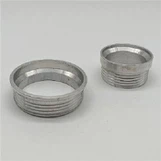
As a supplier of custom titanium parts, I often get asked whether our products can be used in high-temperature environments. This is a crucial question, especially for industries such as aerospace, automotive, and energy, where high temperatures are a common challenge. In this blog post, I'll delve into the properties of titanium, how it behaves under high temperatures, and the applications of custom titanium parts in high-temperature settings.
Properties of Titanium
Titanium is a remarkable metal known for its high strength-to-weight ratio, excellent corrosion resistance, and biocompatibility. These properties make it a popular choice in various industries. When it comes to high-temperature applications, the thermal properties of titanium are of particular interest.
Titanium has a relatively high melting point, around 1668°C (3034°F). This high melting point indicates that titanium can withstand high temperatures before it starts to melt. However, the performance of titanium at high temperatures is not solely determined by its melting point. Other factors, such as oxidation resistance and mechanical strength at elevated temperatures, also play significant roles.
Oxidation Resistance at High Temperatures
One of the key challenges in using metals in high-temperature environments is oxidation. Oxidation occurs when a metal reacts with oxygen in the air, forming metal oxides on the surface. This can lead to a loss of material, a decrease in mechanical properties, and ultimately, the failure of the component.
Titanium forms a thin, protective oxide layer on its surface when exposed to air at room temperature. This oxide layer is stable and provides excellent corrosion resistance. However, at high temperatures, the oxidation rate of titanium increases. The protective oxide layer can break down, and the metal can react more rapidly with oxygen.
To improve the oxidation resistance of titanium at high temperatures, various surface treatments can be applied. For example, coatings can be used to provide an additional barrier between the titanium and the oxygen in the air. These coatings can be made of materials such as ceramics or other metals with high oxidation resistance.
Mechanical Strength at High Temperatures
In addition to oxidation resistance, the mechanical strength of titanium at high temperatures is also important. As the temperature increases, the mechanical properties of most metals, including titanium, tend to decrease. This is because the atoms in the metal have more energy at higher temperatures, making it easier for them to move and deform.
However, titanium alloys can be designed to maintain their mechanical strength at high temperatures. By adding alloying elements such as aluminum, vanadium, and molybdenum, the microstructure of the titanium alloy can be modified to improve its high-temperature performance. For example, some titanium alloys can maintain their strength up to 600°C (1112°F) or even higher.
Applications of Custom Titanium Parts in High-Temperature Environments
Despite the challenges associated with using titanium in high-temperature environments, custom titanium parts are still widely used in many industries. Here are some examples:
Aerospace Industry
The aerospace industry is one of the largest users of custom titanium parts in high-temperature environments. Titanium is used in aircraft engines, where temperatures can reach several hundred degrees Celsius. For example, titanium alloys are used in compressor blades, turbine discs, and engine casings. These components need to withstand high temperatures, high pressures, and high mechanical stresses.
In addition to aircraft engines, titanium is also used in other aerospace applications, such as spacecraft structures and heat shields. In these applications, the high strength-to-weight ratio and corrosion resistance of titanium are also important factors.
Automotive Industry
The automotive industry is also starting to use more custom titanium parts in high-temperature environments. For example, titanium exhaust systems are becoming increasingly popular in high-performance cars. The high-temperature resistance and lightweight properties of titanium make it an ideal material for exhaust systems, which need to withstand the high temperatures generated by the engine.
Energy Industry
The energy industry, including oil and gas, nuclear, and renewable energy, also uses custom titanium parts in high-temperature environments. In oil and gas exploration and production, titanium is used in downhole tools and pipelines, where it needs to withstand high temperatures and corrosive environments. In nuclear power plants, titanium is used in heat exchangers and other components, where it needs to maintain its mechanical properties at high temperatures.


Custom Titanium Parts for High-Temperature Applications
As a supplier of custom titanium parts, we have the expertise and capabilities to produce high-quality parts for high-temperature applications. We use advanced manufacturing processes, such as Titanium CNC Milling Parts and Titanium CNC Turning Parts, to ensure the precision and quality of our parts.
We also work closely with our customers to understand their specific requirements and develop customized solutions. Whether it's a component for an aircraft engine, an exhaust system for a high-performance car, or a downhole tool for the oil and gas industry, we can provide the right titanium parts for the job.
Contact Us for High-Temperature Titanium Parts
If you're looking for custom titanium parts for high-temperature applications, we'd love to hear from you. Our team of experts can provide you with more information about our products, manufacturing processes, and how we can meet your specific needs. Contact us today to start the conversation and explore the possibilities of using custom titanium parts in your high-temperature applications.
References
- "Titanium: A Technical Guide" by John R. Davis
- "High-Temperature Materials and Coatings" by Robert A. Rapp
- "Materials Science and Engineering: An Introduction" by William D. Callister, Jr. and David G. Rethwisch