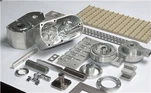
Hardware processing refers to the various operations and techniques used to manufacture, modify, or finish physical components, typically made from metals or other hard materials. This process is a critical part of the manufacturing industry and involves several key steps and technologies. Here's an introduction to hardware processing in English:
Machining: This is the process of using machine tools to cut, shape, and finish workpieces. Common types of machining include milling, turning, drilling, and grinding.
Casting: Involves pouring molten metal into a mold and allowing it to solidify. Once cooled, the part is removed from the mold, a process used for creating complex shapes that are difficult to achieve through machining.
Forging: A process where metal is shaped by applying localized compressive forces. Forging enhances the grain structure of the metal, making it stronger.
Stamping: Used for shaping metal sheets, typically by pressing them between a matched set of dies. This is a cost-effective method for producing large quantities of parts.
CNC Machining: Computer Numerical Control (CNC) machining utilizes computer programs to control machine tools, allowing for high precision and repeatability in part production.
Grinding: A finishing process that involves removing material from a workpiece to achieve a desired shape, size, or finish. It's often used to produce very fine surfaces.
Polishing: A process that uses fine abrasives to improve the surface finish of a part, often to a mirror-like finish.
Heat Treatment: This involves heating and cooling metal in a controlled manner to alter its physical properties, such as hardness, strength, or ductility.
Plating: Applying a thin layer of metal to a surface to improve its corrosion resistance, wear resistance, or appearance.
Assembly: The process of joining individual components together to form a complete device or product.
Inspection and Quality Control: Throughout hardware processing, parts are inspected for defects and measured for accuracy to ensure they meet the required specifications.
Rapid Prototyping: The use of 3D printing and other advanced manufacturing techniques to quickly produce prototypes of parts for testing and design validation.
Tooling and Dies: Specialized tools, such as injection molds or stamping dies, are often created for the production of hardware components.
Finishing: Final operations that may include deburring, cleaning, painting, or coating to prepare the part for its intended use.
Hardware processing is a multifaceted field that combines engineering, material science, and craftsmanship to create the components that form the building blocks of many products and machinery. It plays a vital role in a wide range of industries, from automotive and aerospace to consumer electronics and construction.