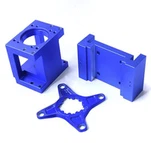
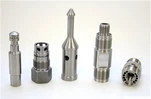
Mechanical machining production encompasses various manufacturing approaches, each tailored to specific production volumes, product complexity, and market requirements. These production types range from custom single-part manufacturing to high-volume mass production, utilizing different technologies, workflows, and management strategies. Understanding these distinct production types enables manufacturers to optimize efficiency, quality, and cost-effectiveness across diverse industrial applications.
1. Prototype Machining Production
Prototype machining focuses on creating initial parts for design validation and functional testing:
Characteristics:
Low Volume: Typically 1-50 pieces
Fast Turnaround: Lead times of days to weeks
Design Flexibility: Easy modification and iteration
High Precision: Tolerances within ±0.01mm
Cost per Unit: Higher due to setup costs spread over few parts
Applications:
Concept validation and proof-of-concept
Engineering validation testing (EVT)
Design verification testing (DVT)
Functional performance evaluation
Market testing and investor demonstrations
Processes:
Rapid CNC machining with minimal fixturing
Multi-axis machining for complex geometries
Quick-change tooling systems
Manual programming for simple parts
Surface finishing for aesthetic evaluation
2. Small-Batch Production
Small-batch production bridges the gap between prototyping and full-scale manufacturing:
Characteristics:
Volume Range: 50-500 pieces
Lead Time: 2-6 weeks typical
Flexibility: Moderate design changes possible
Cost Efficiency: Better unit costs than prototyping
Quality Systems: Basic inspection protocols
Applications:
Market testing and demand validation
Bridge production before full-scale manufacturing
Spare parts manufacturing
Customized products
Seasonal or limited-edition items
Advantages:
Lower inventory risk
Responsive to market changes
Reduced upfront investment
Faster time-to-market
Quality validation before mass production
3. Batch Production
Batch production involves manufacturing fixed quantities of identical parts:
Characteristics:
Volume Range: 500-10,000 pieces
Production Runs: Discrete batches with setup changes
Planning: Detailed scheduling and resource allocation
Quality Control: Statistical process control implementation
Tooling: Dedicated fixtures and tooling systems
Key Features:
Economic Batch Quantity: Optimized lot sizes minimize setup costs
Flexible Manufacturing: Ability to switch between different products
Inventory Management: Controlled work-in-progress levels
Process Documentation: Standard operating procedures
Skill Requirements: Trained operators for specialized equipment
Production Planning:
Material requirement planning (MRP)
Capacity planning and load balancing
Setup time optimization
Quality assurance protocols
Delivery schedule coordination
4. Mass Production
Mass production manufactures large quantities of standardized products:
Characteristics:
High Volume: 10,000+ pieces annually
Automation: Extensive use of automated systems
Standardization: Minimal product variation
Cost Efficiency: Lowest unit costs through economies of scale
Continuous Flow: Uninterrupted production processes
Technologies:
Dedicated production lines
Automated tool changers
Palletized machining systems
Robotic loading/unloading
In-line quality inspection systems
Benefits:
Minimal labor costs per unit
Consistent product quality
Predictable production schedules
Reduced inventory costs
Competitive pricing advantages
5. Continuous Production
Continuous production represents the highest level of manufacturing automation:
Characteristics:
24/7 Operation: Non-stop production cycles
Minimal Human Intervention: Fully automated processes
Real-time Monitoring: Continuous process control
Predictive Maintenance: Preventive equipment care
Zero Defects: Statistical quality control targets
Systems Integration:
Enterprise resource planning (ERP)
Manufacturing execution systems (MES)
Computer-aided process planning (CAPP)
Statistical process control (SPC)
Total productive maintenance (TPM)
6. Job Shop Production
Job shop production specializes in custom manufacturing:
Characteristics:
Custom Products: Unique or low-volume items
High Flexibility: Wide range of capabilities
Skilled Workforce: Experienced machinists and programmers
General Purpose Equipment: Versatile machine tools
Project-based: Customer-specific requirements
Applications:
Tool and die making
Mold manufacturing
Repair and maintenance parts
Research and development components
Specialized industrial equipment
7. Cellular Manufacturing
Cellular manufacturing organizes equipment into product-focused cells:
Structure:
U-shaped Layout: Optimized material flow
Multi-skilled Operators: Cross-trained personnel
Quick Changeover: Reduced setup times
Pull Production: Demand-driven manufacturing
Continuous Improvement: Kaizen implementation
Advantages:
Reduced material handling
Shorter lead times
Improved quality control
Enhanced flexibility
Better space utilization
Production Selection Criteria
Volume Considerations:
Prototype: 1-50 pieces
Small Batch: 50-500 pieces
Batch: 500-10,000 pieces
Mass: 10,000+ pieces
Product Complexity:
Simple: Standard machining operations
Moderate: Multi-process requirements
Complex: 5-axis and specialized operations
High Precision: Tight tolerances and surface finishes
Market Requirements:
Time-to-Market: Speed of delivery
Cost Constraints: Budget limitations
Quality Standards: Industry specifications
Flexibility: Design change accommodation
Technology Integration
Digital Manufacturing:
CAD/CAM integration
Digital thread connectivity
Real-time production monitoring
Predictive analytics
Cloud-based collaboration
Industry 4.0 Elements:
Internet of Things (IoT) sensors
Artificial intelligence optimization
Machine learning algorithms
Cyber-physical systems
Big data analytics
Quality Management Systems
Quality Assurance Methods:
First article inspection
Statistical process control
Total quality management
Six Sigma methodologies
Lean manufacturing principles
Certification Standards:
ISO 9001 quality management
AS9100 aerospace standards
ISO/TS 16949 automotive
ISO 13485 medical devices
NADCAP special processes