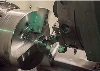
The three commonly used types of turning tools in precision part machining are pointed turning tools, radiused turning tools, and formed turning tools. Nanjing Moreon Machinery specializes in precision part machining, offering full-process control capabilities from prototyping and model making to mass production and surface treatment. They provide high-quality and high-precision mechanical machining and assembly services for core components to demanding customers such as medical in vitro diagnostic equipment.
Pointed Turning Tools. Turning tools characterized by straight cutting edges are commonly known as pointed turning tools. The tip of this type of turning tool (also known as its positioning point) is composed of a straight primary cutting edge and secondary cutting edge, such as 90-degree internal and external turning tools, left and right turning tools, parting (grooving) turning tools, and various external and internal turning tools with small edges and inverted tips. When machining parts with this type of turning tool, the contour shape of the part is primarily obtained by the displacement of an independent tip or a straight primary cutting edge, which is fundamentally different from the principle of part contour shape obtained when machining with the other two types of turning tools. The selection of geometric angles for pointed turning tools is basically the same as for ordinary turning, but it should be comprehensively considered whether it is suitable for the characteristics of machining (such as machining path) and whether there is any machining interference, while also taking into account the strength of the tip itself.
Radiused Turning Tools. Radiused turning tools are special turning tools used for precision part machining. They are a type of turning tool characterized by a circular arc cutting edge with small circular arc error or line profile error. Every point on the circular arc cutting edge is the tip of the radiused turning tool. Therefore, the tool positioning point is not on the arc but at the center of the arc. When some pointed turning tools or formed turning tools (such as thread turning tools) have a certain circular arc shape, they can also be used as this type of turning tool.
Formed Turning Tools. Formed turning tools are commonly referred to as pattern turning tools, where the contour shape of the machined part is entirely determined by the shape and size of the cutting edge of the turning tool. In precision part machining, common formed turning tools include small radius arc turning tools, non-rectangular groove turning tools, and thread turning tools. During the machining process, the use of formed turning tools should be minimized. When it is indeed necessary to select them, detailed explanations should be provided in the process preparation documents or process step tables.
Nanjing Moreon Machinery specializes in manufacturing precision metal and non-metal component assemblies, with machining scope including but not limited to high-precision medical in vitro diagnostic instruments, robots, intelligent equipment, analytical instruments, optical instruments, 5G equipment, oil equipment, new energy equipment, etc. They have mature machining experience in the fields of irregular structural parts, in vitro diagnostic precision instrument accessories, high-precision shafts, and analytical instrument equipment.