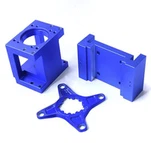
Precision mechanical machining is a manufacturing process that creates high-precision components with desirable surface finishes to tight design tolerances. It is a subtractive process, transforming workpieces into finished parts or products by precisely removing material through various operations such as turning, drilling, milling, and grinding. Here is an overview of the precision mechanical machining process:
CAD Design: The process begins with a digital 3D computer-aided design (CAD) model of the desired part, which includes precise specifications for dimensions, tolerances, materials, and more based on the part's function .
CNC Programming: The CAD model data is converted into a numeric code containing manufacturing instructions for the CNC machine tool via computer-aided manufacturing (CAM) software. This computer numerical control (CNC) code guides the motions of the machine .
Fixturing: The proper stock material is selected and precisely fixtured in the CNC equipment using clamps, vices, or adhesive. Common materials used in precision machining include metals, plastics, glass, and ceramics due to their strength and ability to hold tight tolerances .
Tool Setup: The machinist initiates the CNC program, which executes the manufacturing sequence by directing machine movements, spindle rotation speeds, cutting tool selection, depth of cuts, feed rates, and more. Multiple axes of motion may shape the material using technologies like milling, turning, electrical discharge machining (EDM), laser, and plasma cutting .
Machining: This step involves the machine controlling the tool according to the programmed instructions to create high-precision and complex parts. Further precision finishing, polishing, deburring, coating, heat treatment, or other secondary operations may be applied per requirements before final inspection. The completed part meets precise form, fit, and function per the original engineering design intent .
Inspection: Quality checks are conducted in-process through manual measurement using instruments like micrometers and calipers as well as automated methods. This verifies dimensional accuracy against the original specifications. Adjustments can be made to achieve exact tolerances .
Types of precision machining techniques used to shape parts and products from various materials include CNC machining, multi-axis CNC machining, Swiss machining, and others, each relying on advanced software and CNC equipment to direct automated machining processes that selectively remove material with extreme accuracy .
Precision machining leverages automated, computer-directed equipment to translate digital blueprints into physical components with uncompromising accuracy, providing accuracy unattainable manually and repeatability for mass production of identical components