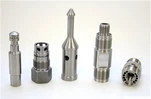
Non-standard parts processing is a specialized manufacturing approach that caters to the unique and specific needs of various industries by creating components that are not mass-produced and do not adhere to standard specifications. This method is highly valued for its ability to provide customization and personalization, which is essential in many sectors where off-the-shelf standard parts may not suffice or where innovation requires specialized solutions.
Here is an overview of non-standard parts processing, highlighting its importance and application across different industries:
High Degree of Personalization and Customization: Non-standard parts are designed and manufactured to meet the specific functional and performance requirements of each customer, leading to a high degree of personalization and customization that is not possible with standard parts. This feature makes non-standard parts widely applicable across various fields, from mechanical manufacturing to the automotive and aerospace industries.1
Unique Designs: Each non-standard part has a unique design tailored to the needs of a particular project or product. This contrasts with standard parts, which are mass-produced with uniform designs.1
Prototyping and Validation: Due to their uniqueness, non-standard parts often undergo prototyping to validate designs before full-scale production. This step ensures that the final parts meet stringent performance and quality standards.1
Rapid Response to Changing Requirements: Non-standard parts processing is highly adaptable, allowing for a quick response to changing design requirements, which is crucial in industries that value innovation and flexibility.1
Widely Applicable in Various Fields: Non-standard parts are used in mechanical manufacturing to create special components and accessories for various types of equipment. In the automotive industry, they are used for special and customized car parts. In aerospace, they are essential for manufacturing parts for aircraft, rockets, and other aviation equipment.1
Technical Expertise and Precision: The technical analysis of non-standard parts processing requires a deep understanding of the part's specifications, requirements, and materials. This process demands a high level of expertise and precision to avoid deviations that could lead to significant issues.4
Flexibility and Efficiency: Non-standard parts processing allows for greater flexibility and customization, which can improve efficiency and reduce costs for manufacturers by creating parts tailored to specific requirements.4
Essential for Construction and Maintenance: In the construction industry, non-standard parts are crucial for creating custom fittings and fixtures necessary for project success. They are also critical for the maintenance and repair of machinery and equipment, where standard parts may not be available or may not meet the necessary performance characteristics.4
Importance for Industry Advancement: With the advancement of technology and the continuous evolution of market demand, non-standard part processing is expected to play an increasingly important role in future development. The ability to customize designs and produce precision components makes non-standard parts a valuable resource in engineering and manufacturing.1
In summary, non-standard parts processing is a critical aspect of modern manufacturing that enables industries to meet the demands of specialized applications, drive innovation, and maintain a competitive edge through tailored component solutions