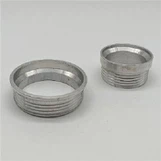
When it comes to custom titanium parts, one of the fundamental properties that engineers, designers, and manufacturers need to understand is density. Density plays a crucial role in various aspects of engineering and manufacturing, from material selection to part design and performance prediction. As a supplier of custom titanium parts, I am here to shed light on what the density of custom titanium parts is and why it matters.
Understanding Density
Density is defined as the mass of a substance per unit volume. Mathematically, it is expressed as ρ = m/V, where ρ represents density, m is mass, and V is volume. The density of a material is an intrinsic property, meaning it remains constant regardless of the size or shape of the sample. In SI units, density is typically measured in kilograms per cubic meter (kg/m³). However, in some industries, other units such as grams per cubic centimeter (g/cm³) are also commonly used.
The Density of Titanium
Titanium is a lustrous transition metal with a density that varies depending on its alloy composition and manufacturing process. Pure titanium has a density of approximately 4.506 g/cm³ (4,506 kg/m³). This is relatively low compared to other common metals such as steel, which has a density of around 7.85 g/cm³, and aluminum, which has a density of about 2.7 g/cm³. The low density of titanium, combined with its high strength-to-weight ratio, makes it an attractive material for applications where weight reduction is critical, such as aerospace, automotive, and sports equipment.
Factors Affecting the Density of Custom Titanium Parts
While the density of pure titanium is well-established, the density of custom titanium parts can deviate from this value due to several factors:
- Alloying Elements: Titanium is often alloyed with other elements such as aluminum, vanadium, and molybdenum to enhance its mechanical properties. These alloying elements can increase or decrease the density of the resulting titanium alloy. For example, titanium-aluminum-vanadium alloys, which are widely used in aerospace applications, typically have densities ranging from 4.4 to 4.5 g/cm³.
- Porosity: The presence of porosity in custom titanium parts can significantly affect their density. Porosity can be introduced during the manufacturing process, such as powder metallurgy or casting. Parts with high porosity will have a lower density compared to fully dense parts.
- Heat Treatment: Heat treatment can alter the microstructure of titanium alloys, which in turn can affect their density. For example, some heat treatment processes can cause phase transformations in the alloy, leading to changes in density.
Importance of Density in Custom Titanium Parts
The density of custom titanium parts has several implications for engineering and manufacturing:
- Weight Calculation: Accurate knowledge of the density of titanium parts is essential for calculating their weight. This is particularly important in applications where weight is a critical factor, such as aerospace and automotive industries. By knowing the density, engineers can optimize the design of parts to achieve the desired weight while maintaining the required strength and performance.
- Material Selection: The density of a material is one of the key factors considered during material selection. In applications where weight reduction is a priority, titanium's low density makes it an attractive choice compared to other metals. On the other hand, in applications where high density is required, such as radiation shielding, other materials may be more suitable.
- Performance Prediction: The density of a material affects its mechanical, thermal, and acoustic properties. Understanding the density of custom titanium parts is crucial for predicting their performance in various operating conditions. For example, the density of a titanium component can influence its natural frequency, which is important in vibration analysis.
Applications of Custom Titanium Parts Based on Density
The unique density properties of titanium make it suitable for a wide range of applications:
- Aerospace Industry: In the aerospace industry, weight reduction is a top priority to improve fuel efficiency and performance. Custom titanium parts, with their low density and high strength-to-weight ratio, are widely used in aircraft components such as engine parts, airframe structures, and landing gears. For more information on custom titanium parts for aerospace applications, you can visit our Titanium CNC Milling Parts page.
- Automotive Industry: Titanium's low density also makes it an attractive material for the automotive industry. It can be used in engine components, exhaust systems, and suspension parts to reduce weight and improve performance. Our Titanium CNC Turning Parts are suitable for automotive applications, offering high precision and quality.
- Sports Equipment: Titanium is commonly used in sports equipment such as golf clubs, tennis rackets, and bicycle frames. Its low density allows for lighter and more maneuverable equipment, while its high strength ensures durability.
How We Ensure Density Precision in Custom Titanium Parts
As a supplier of custom titanium parts, we understand the importance of density precision. We take several measures to ensure that our parts meet the required density specifications:
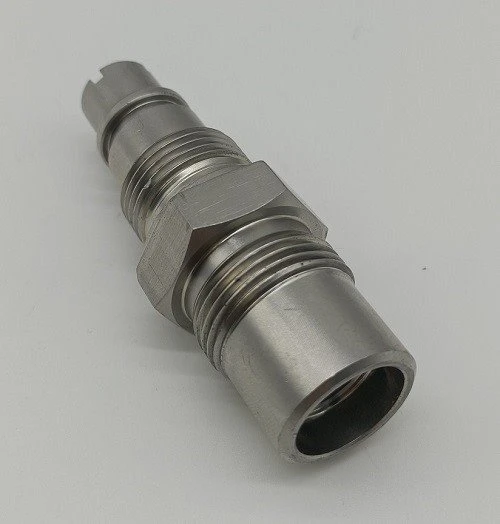

- Material Selection: We source high-quality titanium alloys from reputable suppliers. Before using any material, we conduct thorough quality checks to ensure its density and other properties meet our standards.
- Manufacturing Process Control: We use advanced manufacturing processes such as CNC machining, which allows for precise control of part dimensions and density. Our experienced technicians monitor the manufacturing process closely to minimize the introduction of porosity and other defects that could affect density.
- Quality Testing: After manufacturing, we perform density testing on our custom titanium parts using state-of-the-art equipment. This ensures that our parts meet the specified density requirements and quality standards.
Contact Us for Custom Titanium Parts
If you are in need of custom titanium parts, we are here to help. Our team of experts can work with you to understand your specific requirements and provide high-quality parts that meet your needs. Whether you need Titanium CNC Milling Parts or Titanium CNC Turning Parts, we have the capabilities and expertise to deliver. Contact us today to start a discussion about your project and explore how our custom titanium parts can benefit your application.
References
- ASM Handbook, Volume 2: Properties and Selection: Nonferrous Alloys and Special-Purpose Materials.
- Callister, W. D., & Rethwisch, D. G. (2017). Materials Science and Engineering: An Introduction. Wiley.
- Schmid, F., & Schmid-Fetzer, R. (2016). Titanium and Titanium Alloys: Fundamentals and Applications. Wiley-VCH.