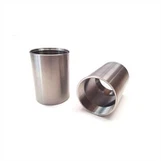
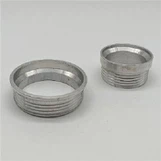
As a dedicated supplier of Titanium Stem Parts, I've had the privilege of witnessing the evolution and application of these components in the cycling industry. One of the most common questions I encounter from customers is about the differences between forged and machined titanium stem parts. In this blog post, I'll delve into the details of these two manufacturing processes, their characteristics, and how they impact the final product.
Manufacturing Processes
Forging
Forging is a manufacturing process that involves shaping metal by applying compressive forces. In the case of titanium stem parts, the titanium billet is heated to a specific temperature and then hammered or pressed into the desired shape using dies. This process aligns the grain structure of the titanium, which results in a stronger and more durable part.
The forging process can be further divided into two main types: open-die forging and closed-die forging. Open-die forging involves shaping the metal between two flat or simple-shaped dies, while closed-die forging uses a pair of dies with a cavity that matches the final shape of the part. Closed-die forging is more commonly used for manufacturing titanium stem parts as it allows for greater precision and control over the final shape.


Machining
Machining, on the other hand, is a subtractive manufacturing process that involves removing material from a workpiece to create the desired shape. In the case of titanium stem parts, a titanium bar or block is typically used as the starting material. The part is then machined using various cutting tools, such as end mills, drills, and lathes, to achieve the final shape.
Machining offers a high degree of flexibility and precision, as it allows for the creation of complex shapes and features. However, it can be a time-consuming and expensive process, especially for parts with intricate designs.
Characteristics of Forged and Machined Titanium Stem Parts
Strength and Durability
Forged titanium stem parts are generally stronger and more durable than machined parts. This is because the forging process aligns the grain structure of the titanium, which improves its mechanical properties. The aligned grain structure also helps to prevent crack propagation, making the part more resistant to fatigue and impact.
Machined titanium stem parts, while still strong, may have a less uniform grain structure due to the material removal process. This can make them more susceptible to cracking and failure under high-stress conditions. However, with proper design and manufacturing techniques, machined parts can still provide excellent strength and durability.
Precision and Tolerance
Machining offers a higher degree of precision and tolerance than forging. This is because the cutting tools used in machining can be controlled with great accuracy, allowing for the creation of parts with tight tolerances. Machined parts also have a smoother surface finish, which can improve the aesthetics and functionality of the part.
Forging, on the other hand, may have slightly lower precision and tolerance compared to machining. This is because the forging process involves shaping the metal under high pressure, which can cause some deformation and variation in the final shape. However, modern forging techniques and equipment have significantly improved the precision and tolerance of forged parts, making them suitable for a wide range of applications.
Cost
The cost of forged and machined titanium stem parts can vary depending on several factors, such as the complexity of the design, the quantity of parts required, and the manufacturing process used. In general, forging is a more cost-effective process for producing large quantities of parts with simple designs. This is because the forging process is relatively fast and efficient, and the tooling costs can be spread over a large number of parts.
Machining, on the other hand, is typically more expensive for producing large quantities of parts. This is because the machining process is more time-consuming and requires more expensive equipment and cutting tools. However, machining is often the preferred choice for producing small quantities of parts with complex designs, as it offers greater flexibility and precision.
Applications of Forged and Machined Titanium Stem Parts
Forged Titanium Stem Parts
Forged titanium stem parts are commonly used in high-performance cycling applications, such as mountain bikes, road bikes, and track bikes. Their strength and durability make them ideal for handling the high stresses and forces encountered in these types of bikes. Forged stem parts are also popular among professional cyclists and enthusiasts who demand the best performance and reliability from their equipment.
Machined Titanium Stem Parts
Machined titanium stem parts are often used in custom or specialty cycling applications, where precision and aesthetics are of utmost importance. Their ability to create complex shapes and features makes them suitable for creating unique and personalized stem designs. Machined stem parts are also commonly used in high-end cycling components, where the cost is less of a concern and the focus is on performance and quality.
Conclusion
In conclusion, both forged and machined titanium stem parts have their own unique advantages and disadvantages. Forged parts offer strength, durability, and cost-effectiveness, making them ideal for high-performance cycling applications. Machined parts, on the other hand, offer precision, flexibility, and aesthetics, making them suitable for custom and specialty cycling applications.
As a supplier of Titanium Stem Parts, I understand the importance of providing high-quality products that meet the specific needs of my customers. Whether you're looking for a strong and durable forged stem part or a precise and aesthetically pleasing machined stem part, I can help you find the right solution for your cycling needs.
If you're interested in learning more about our Titanium Stem Parts or have any questions about the differences between forged and machined parts, please don't hesitate to contact me. I'd be happy to discuss your requirements and provide you with a quote.
We also offer a wide range of other cycling components, including the Bike Stem Riser Bike Fork Stem Extender Bicycle Handlebar Raiser Head Up Adapter Suitable For Mountain Bike, Road Bike, MTB, BMX, Fixie (Aluminium Alloy, Adjustable). If you're looking to enhance the performance and comfort of your bike, be sure to check out our product catalog.
Thank you for reading, and I look forward to hearing from you soon!
References
- ASM Handbook, Volume 14A: Metalworking: Forging, ASM International
- Manufacturing Engineering and Technology, Fifth Edition, by Serope Kalpakjian and Steven Schmid
- Titanium: A Technical Guide, Second Edition, by David Eylon