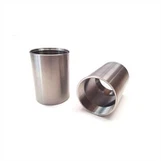
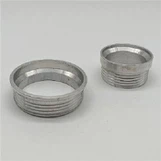
Hey there! As a supplier of custom titanium parts, I've seen firsthand the amazing advantages these parts bring to the table. In this blog, I'm gonna break down why custom titanium parts are a game - changer in various industries.
1. Exceptional Strength - to - Weight Ratio
One of the most significant perks of custom titanium parts is their outstanding strength - to - weight ratio. Titanium is incredibly strong, yet it's much lighter than steel. For instance, in the aerospace industry, every ounce matters. Using custom titanium parts can reduce the overall weight of an aircraft without sacrificing strength. This means better fuel efficiency and lower operating costs.
Imagine building a high - performance racing car. With custom titanium parts, you can make components like engine valves or suspension parts stronger and lighter. This improves the car's acceleration, handling, and overall performance. Whether it's a small, precision - engineered part or a larger structural component, titanium's strength - to - weight ratio gives it a huge edge.

2. Corrosion Resistance
Titanium is highly resistant to corrosion, even in harsh environments. It forms a thin, protective oxide layer on its surface when exposed to oxygen. This layer acts as a shield, preventing further corrosion.
In the marine industry, custom titanium parts are a godsend. Saltwater is extremely corrosive, and regular metals would quickly rust and deteriorate. But titanium parts, such as propellers, fasteners, and hull components, can withstand the salty sea water for years without significant damage.

In the chemical processing industry, where parts are exposed to corrosive chemicals, custom titanium parts offer long - term durability. They can handle acids, alkalis, and other aggressive substances, ensuring the smooth operation of chemical plants. You can check out our Titanium CNC Milling Parts which are often used in these kinds of harsh environments.
3. Biocompatibility
Titanium is biocompatible, which means it's well - tolerated by the human body. This property makes it a top choice for medical applications. Custom titanium parts are used in a wide range of medical devices, from dental implants to orthopedic implants.
Dental implants made from titanium integrate well with the jawbone, providing a stable foundation for artificial teeth. Orthopedic implants, such as hip and knee replacements, are also commonly made from titanium. The body doesn't reject titanium, and it can last for a long time, improving the quality of life for patients.

The biocompatibility of titanium also extends to other medical equipment. Surgical instruments made from titanium are lightweight and easy to handle, and they don't cause allergic reactions in patients.
4. High - Temperature Resistance
Titanium can maintain its strength and integrity at high temperatures. It has a relatively high melting point and can withstand extreme heat without deforming or losing its properties.
In the automotive industry, custom titanium parts are used in exhaust systems. The exhaust gases can reach very high temperatures, and titanium parts can handle this heat without warping. This ensures the proper functioning of the exhaust system and improves the vehicle's performance.
In the power generation industry, especially in gas turbines, titanium parts are used because of their high - temperature resistance. Gas turbines operate at extremely high temperatures, and titanium components can withstand these conditions, contributing to the efficiency and reliability of the power generation process.

5. Design Flexibility
As a custom titanium parts supplier, I know that one of the great things about titanium is its design flexibility. Titanium can be machined into complex shapes and geometries. With advanced manufacturing techniques like CNC machining, we can create custom titanium parts that meet the most specific requirements.
Whether it's a part with intricate internal channels for fluid flow or a part with a unique external shape for aesthetic or functional reasons, titanium can be shaped to fit the bill. Our Titanium CNC Turning Parts are a prime example of how we can use machining to create precise, custom - designed parts.
6. Low Thermal Expansion
Titanium has a relatively low coefficient of thermal expansion. This means that it doesn't expand or contract significantly when exposed to temperature changes.
In applications where dimensional stability is crucial, such as in precision instruments or aerospace components, custom titanium parts are ideal. For example, in optical instruments, even a small change in dimensions due to temperature variations can affect the accuracy of the instrument. Titanium's low thermal expansion ensures that the parts maintain their shape and performance over a wide range of temperatures.
7. Long - Term Cost Savings
Although the initial cost of custom titanium parts may be higher than some other materials, they offer long - term cost savings. Thanks to their durability, corrosion resistance, and high - temperature resistance, titanium parts have a longer service life.
In industries where downtime for part replacement is costly, such as manufacturing plants or power generation facilities, using custom titanium parts can reduce maintenance and replacement costs. You don't have to keep replacing parts as often, which saves both time and money in the long run.
8. Aesthetic Appeal
Let's not forget about the aesthetic appeal of titanium. It has a unique, modern look that can enhance the appearance of products. In the consumer electronics industry, for example, custom titanium parts are used to give devices a sleek and high - end look.
In the jewelry industry, titanium is becoming increasingly popular. It can be polished to a beautiful finish and is hypoallergenic, making it a great choice for people with sensitive skin.
Contact for Purchase and Discussion
If you're interested in custom titanium parts for your project, whether it's for aerospace, medical, automotive, or any other industry, I'd love to talk to you. We have the expertise and capabilities to provide high - quality custom titanium parts that meet your exact needs. Don't hesitate to reach out and start a conversation about your requirements.
References
- "Titanium: A Technical Guide" by J. R. Davis
- "The Handbook of Titanium Alloys" edited by G. E. Totten and D. Scott MacKenzie